2026 Festival Archive: Untitled Theatre Company No. 61 and Yara Arts Group
Untitled Theatre Company No. 61 and Yara Arts Group: The Left Hand of Darkness
January 29-February 1, 2026
Northwestern University’s Wirtz Center Chicago Abbott Hall
Presented by Chicago International Puppet Theater Festival
With special support from Carol Farver & Robert Needlman, Julie Moller, and The Marshall Frankel Foundation
Scholarship and Resources
Love in Winter:
Untitled Theatre Company No. 61 and Yara Arts Group Envision The Left Hand of Darkness
An Essay by Katherine McNamara
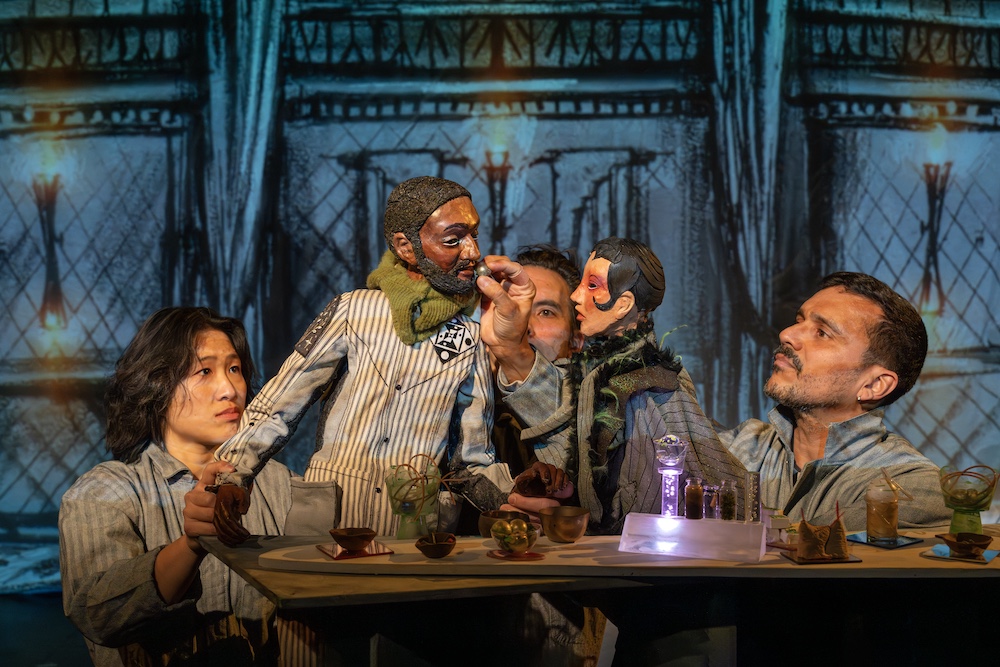
Ursula K. Le Guin in The Left Hand of Darkness imagined a world inhabited by a people she described as ambisexual, that is, not of fixed gender. I wondered how Edward Einhorn and Tom Lee, co-directors (Einhorn also adapted the novel), and their companies would devise these characters for the puppet stage. Their solutions are elegant, often witty, moving, and, with dramatic simplification, follow the book’s concepts and plotline.¹ The play runs for two hours with an interval; I saw it twice.² The two principal characters are Genly Ai, an astronaut and lone envoy from the Ekumen confederation to the outer planet he calls Winter, and his host, the aristocrat-traitor Estraven, who knows this planet, their home, as Gethen.
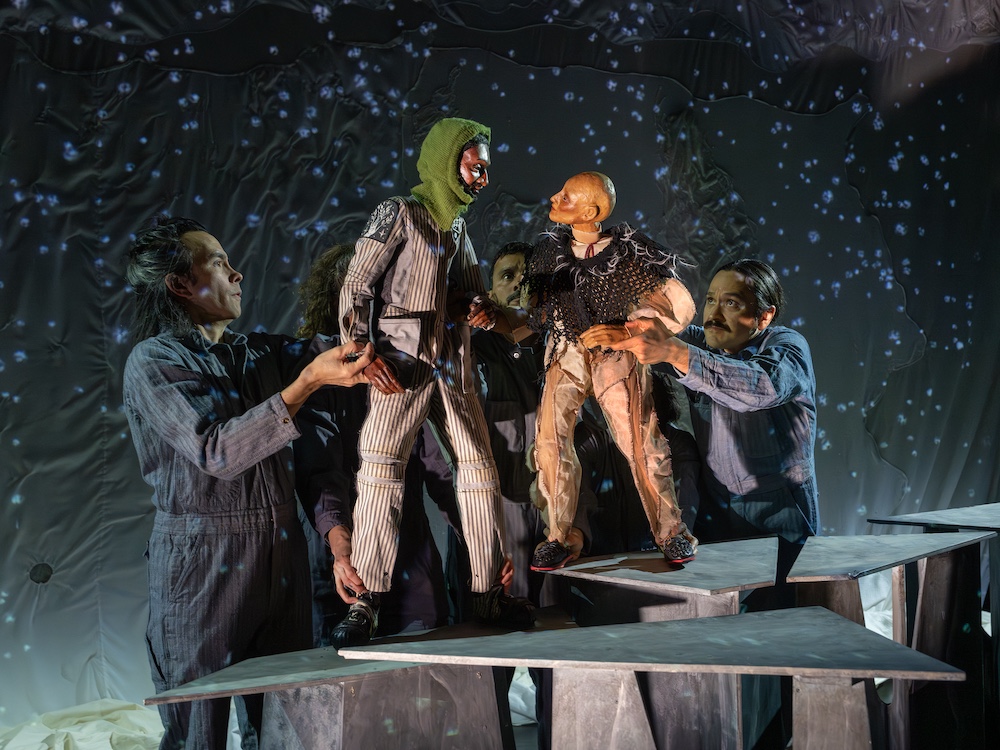
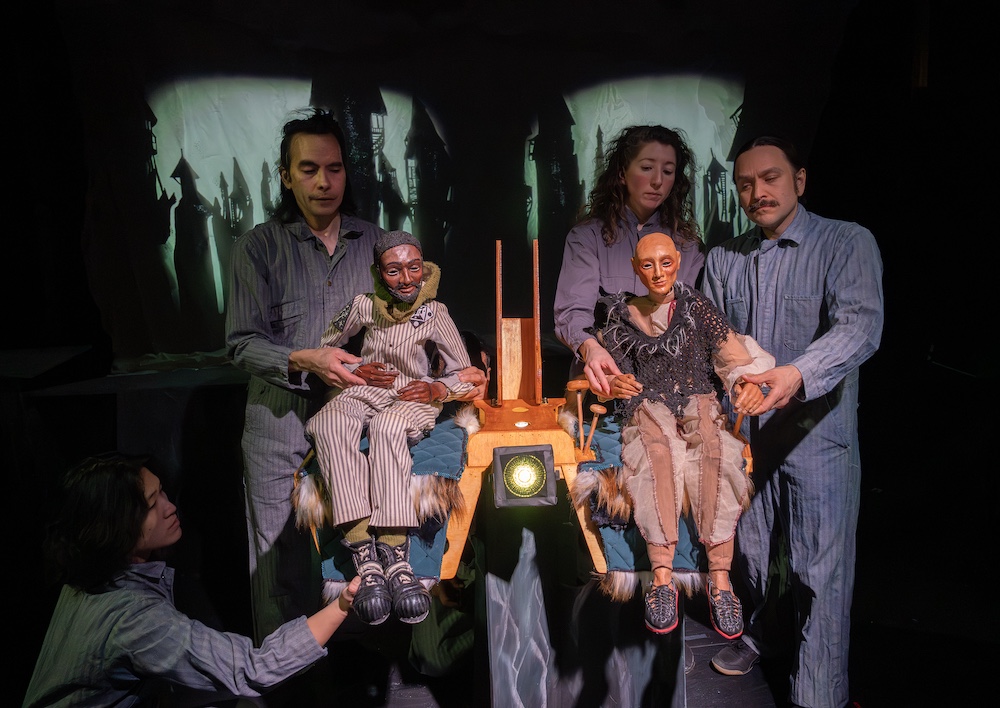
Doubling (and mirroring) is a motif of the play, visually and verbally. Einhorn has updated Le Guin’s conventional universal “he” to “they.” We see them: the two human performers are replicated as puppets. The terrific actors—Miguel Long as Genly Ai, Winter Jones as Estraven—give voice to all of the various puppets and also are narrators. This is a word-saturated play. The great story is many stories with many tellers, told in artfully deployed media, including sound, video, shadow puppetry, and lighting.
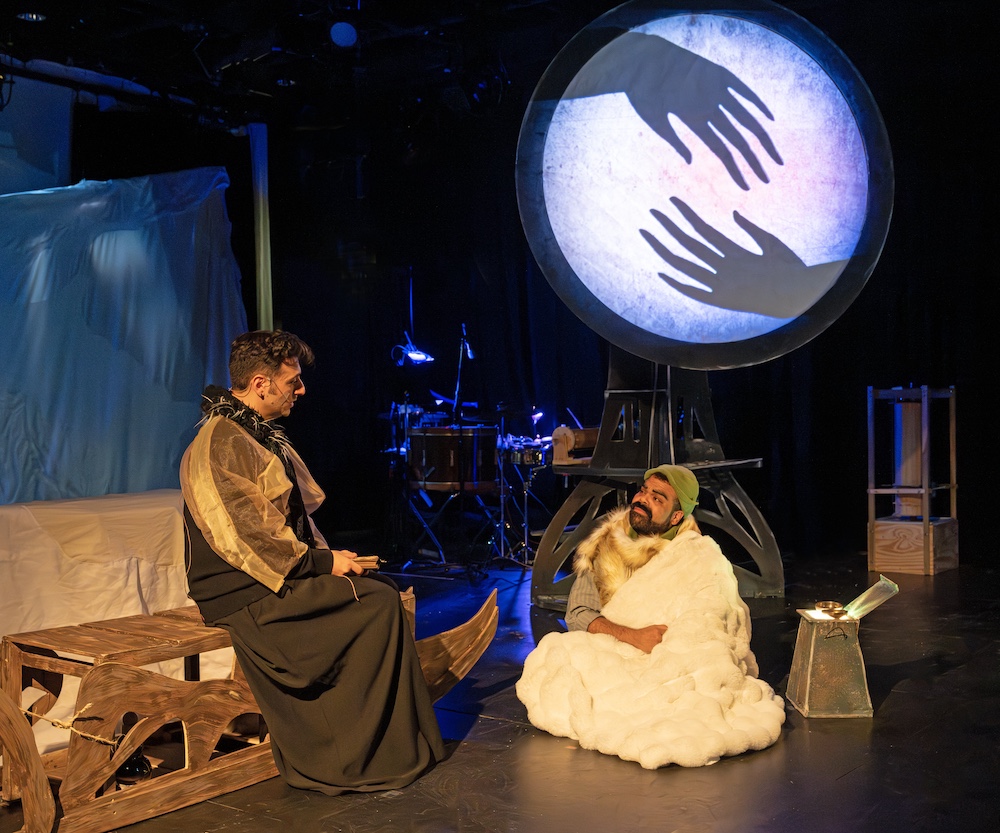
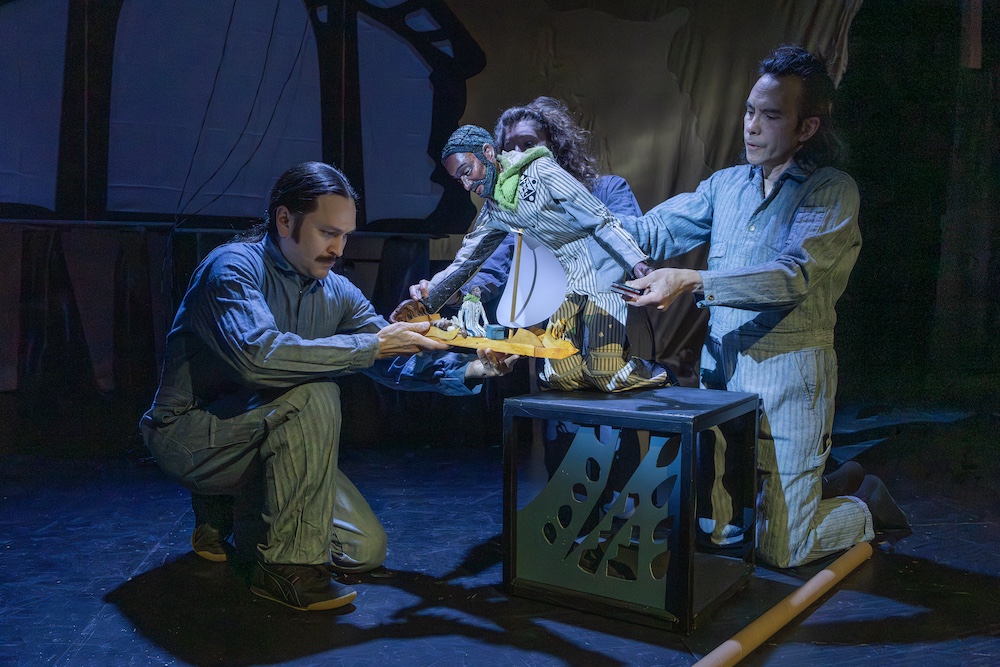
We glimpse Genly Ai first, costumed in a flight suit and helmet. He enters modestly amid astronaut/puppeteers, as they prepare to land the envoy on Winter. Behind them, video imitating endless falling snow runs on a large curtain-sheet. A toy-sized rocket is guided smoothly by the puppeteers to the tabletop stage. The puppet Genly Ai emerges; it is roughly half-body height, also clothed in a space suit, with a molded head, hair, and face. The actor and his puppet are of color. They exit.
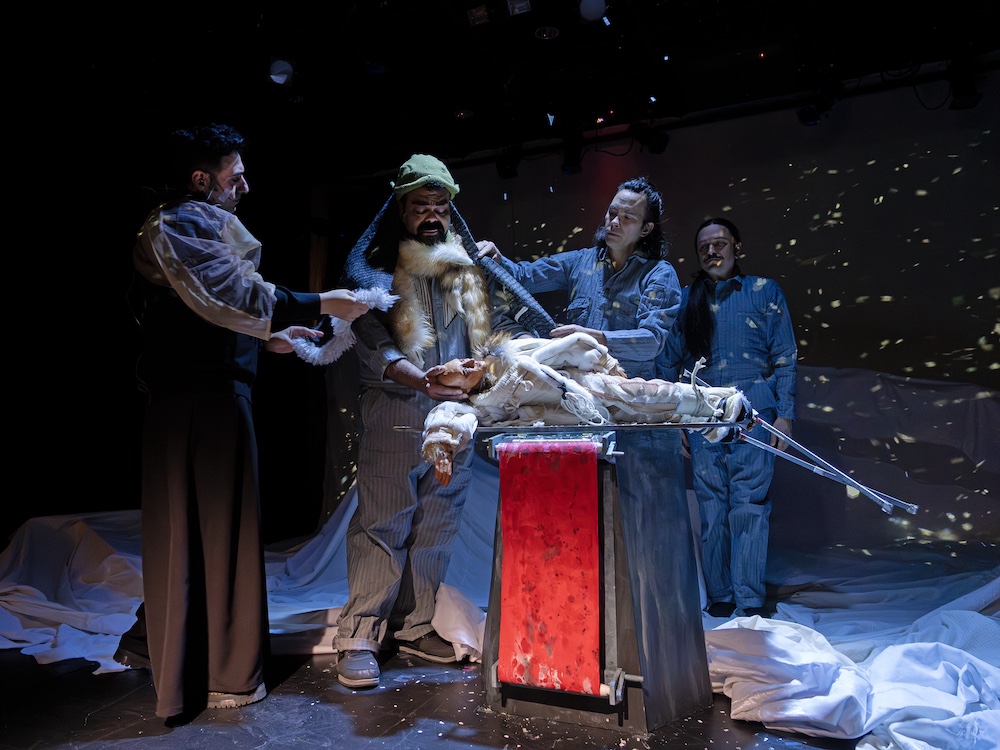
Now Jones as Estraven carries their puppet into the performance space and lays it gently on the tabletop. Its handlers begin to dress it. The figure is also half-height, with an unmarked cloth body and an operating rod in its back. Its molded head is spare, oval, hairless, noble. As its handlers drape its layers of garments, it begins to move (raised by them) and become animate. It is a transformation: An inert puppet comes to—life.
Le Guin wrote a novel of ideas, now called speculative fiction. It is an adventure story, a love story, and also a political story. Einhorn’s adaptation follows closely the author’s thinking and language. Winter/Gethen is no utopia. Wars are not fought in that frigid climate; but a border dispute between two nations, Karhide (where Genly Ai lands) and Ogoreyn, has been argued bitterly for generations.
ESTRAVEN [explaining to Genly Ai]: There are other nations on this world. From what I understand, those who rule Orgoreyn are mostly sane, if unintelligent, while the Monarch Argaven [of Karhide] is not only insane but rather stupid.
Tom Lee and his puppet-makers have constructed these other characters as both amusing and disturbing. The Mad Monarch of Karhide, whom Genly Ai hopes to persuade to join the Ekumen confederation, is a puppet attached like a cascading gilt necklace to its nimble puppeteers, Tom Lee and Emma Wiseman, who perform it as an absolute ruler, a glittering monarch with no self-restraint, hysterical, shrill, mad—and also, pregnant.
“Monarch” rather than “king” evokes at a slant the transformation called “kemmer.” With delicacy, Estraven explains kemmer to Envoy Ai as to a child: It is their cyclical morphing from the neutral state into kemmer, when partners form male and female sexual organs and can generate children. They explain that there are protocols to be followed regarding this transformation.
GENLY: And does everyone have the capacity to be both mother and father?
ESTRAVEN: You truly ask a child’s question. Yes, of course. The joy and the suffering is available to all. It is a difficult process, to have a child of the flesh, but a rewarding one. And when deciding an heir, it is the child of the flesh who receives preference.
Envoy Ai, permanently male, able to be sexually aroused at any time (but chaste on Winter), describes the unequal relations between males and females on his planet. There, genders are fixed—Estraven says gently that this is abhorred as perversion on Gethen—and, socially and politically, gendered males dominate females. Estraven wonders at this. Later, we learn that they had borne a child.
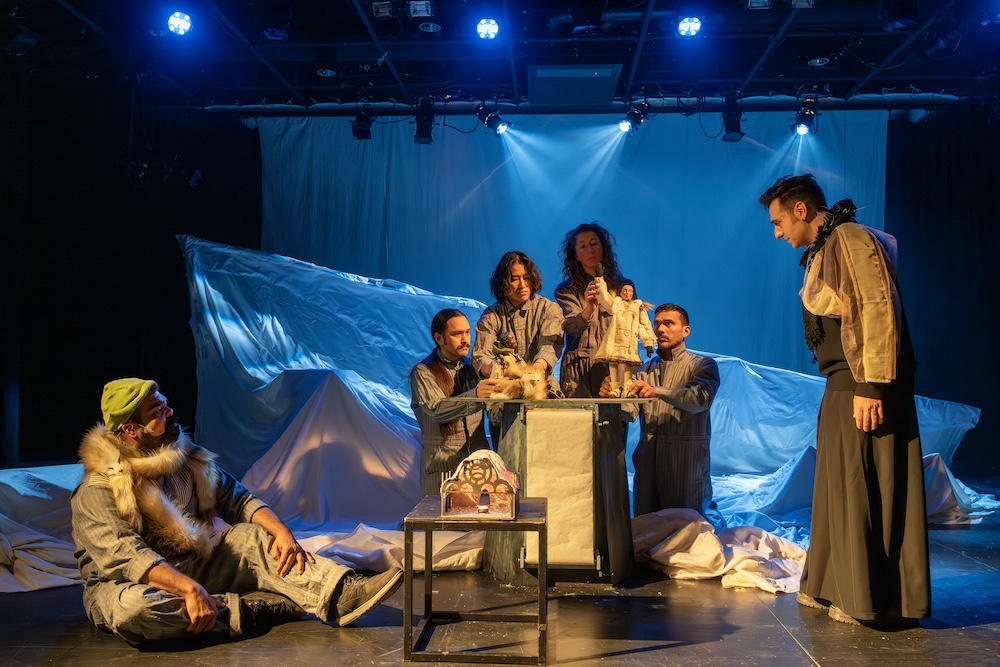
This production is epic in vision yet is performed in simplicity in a fairly small space. To describe the sets, their visual metaphors and puns, their inventive constructions, would require another review entirely. We observe a collage of actors and puppets moving on and off stage. We hear instruments made especially for this play, and the actors’ voices in a range of accents. We see the puppeteers, yet also don’t see them, as they manipulate their figures. There is serenity in them. More than two dozen art workers in two companies, Untitled Theatre Company No. 61 and Yara Arts Group, have made these many parts fit together. There is a visible spirit, an intention, integrity, in this production. What artists often call “the gift relationship” doesn’t mean that art-making is free. It means that we surely are obligated to give back generously so that they may flourish.
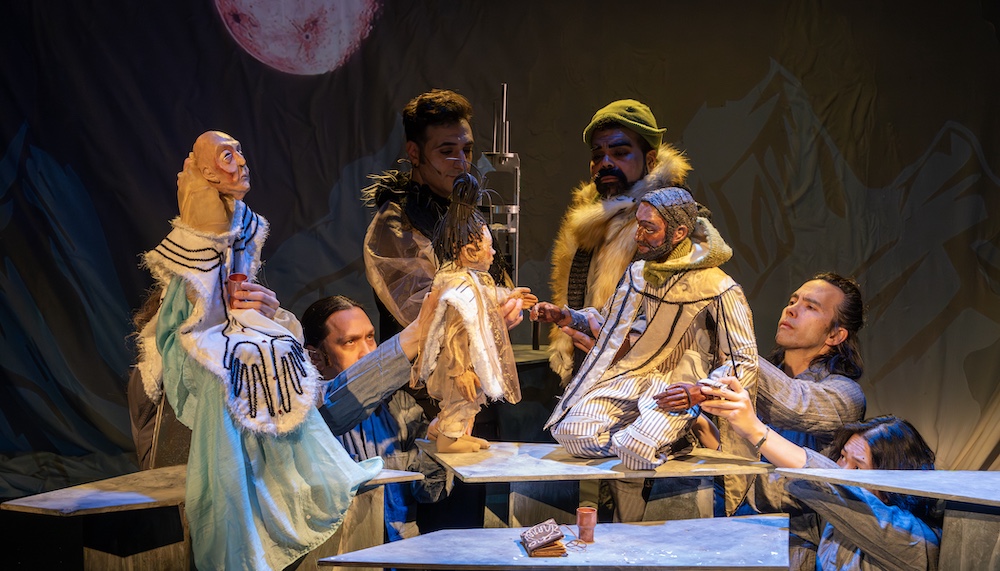
The second act, like the novel, is dominated by the great journey toward safety that Estraven and Genly Ai take across Gobin glacier. That immense sheet of ice is mimicked by the curtain-sheet, now hung and draped to convey heights and treacherous descents. Genly Ai and Estraven are wrapped in furs—they reminded me of Yup’ik dolls—and maneuvered by puppeteers’ hands in sledge and skis across the immense whiteness. Multiple puppets are used to show scale and distance. Their human actors appear alternately, narrating or conveying quiet thoughts. The naive, brave Genley Ai and Estraven, affecting and tragic, grow close. Genly teaches his friend to mindspeak, the one gift Estraven desires. Estraven reveals their personal name, Therem. In mindspeak (visually enacted), Genly’s voice is heard as Arak, Therem’s beloved sibling. The friends are following one set of rules while breaking another: and so, are inwardly mirroring this astonishing, thrilling journey across the barren ice on which none were believed to survive. Finally, they reach their goal, a border town. Genly radios his fellow astronauts to land their ship.³ It is time: Karhide will join the confederation. All seems possible, until Estraven-Therem is exposed as a banished traitor. Border guards fire their lethal weapons; Therem rushes toward them. We feel the grief of Therem’s death—we have come to love them—by suicide, the planet’s great moral taboo.
An effective climax, for dramatically there is no alternative.
Epilogue. Genly Ai visits Esvans, an ancient liege who tends to Sorve, a small child. Esvans tells the envoy of their two offspring, Therem and Arak, who had been in kemmer in their youth, as was allowed, and had conceived a child, whom Therem bore; this is Sorve, child of Therem’s flesh. But the siblings had violated a protocol: They had vowed eternal kemmer after the child was born, a forbidden vow. Arak had died; now Therem also was dead.
We are left with an expression of love in its deepest intimacy. Young Sorve demands in Estraven’s voice, “You crossed the Gobrin ice together, you and my mother? Will you tell me how my mother died?” The two actors now take the puppets of Genly and Sorve. “Will you tell us about the other worlds among the stars? [T]he other kinds of people there, the other lives they lead? Tell us everything.”
¹ Familiarity with the novel enriched my experience of the play; on reflection, I think the play is as accomplished in its own form as the novel in its. I asked several audience members whether they could follow this complex show without having read the book; they said yes. One said, “How he was able to tell such a long, complicated story—consolidating it—but still it was long, two hours, yet we never tired of it.”
² I am grateful to Edward Einhorn, who answered my questions and made the script available to me. Before each show, in the lobby, he acts as docent before a screen with sci-fi-like fonts and imagery, explaining the key words and concepts of the people of this outer planet, Winter/Gethen. I also thank Heather Jarry and, especially, Paulette Richards and Tim Cusack.
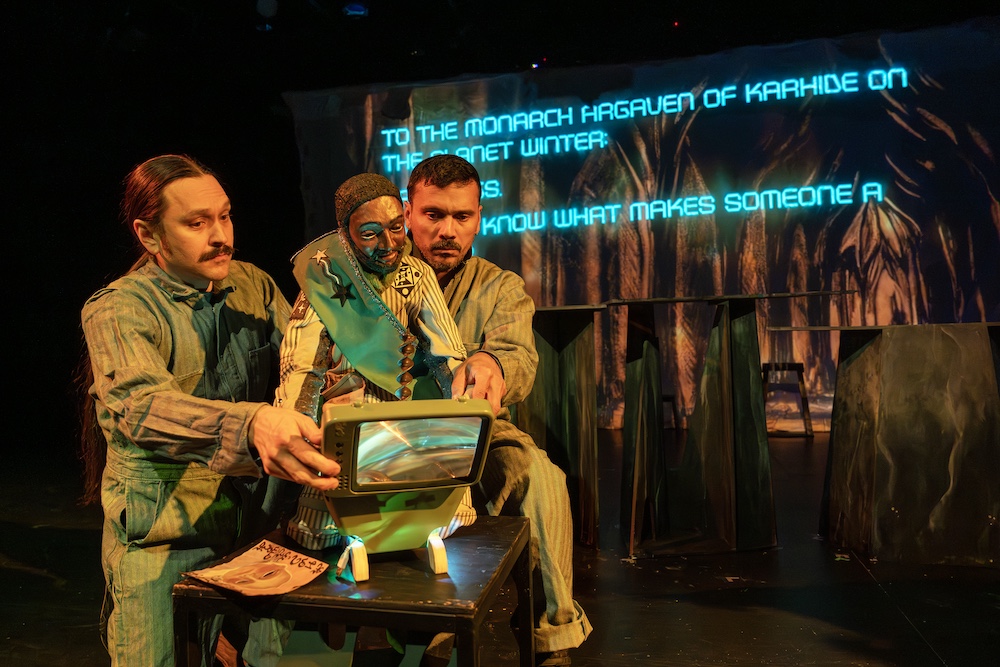
³ The handling of this event is marvelous. Again doubling/mirroring, the puppeteers take a large set piece—a round, flat screen set atop a tall console, used variously to show shadow puppets and other imagery—and deftly rotate it. They tilt the screen to become a satellite dish while turning the console into its steel-girdered base station. The puppet is made to climb this base station. All is done within a few moments.
Festival Performances
About the Performance
 January 29-February 1, 2026
Northwestern University’s Wirtz Center Chicago Abbott Hall, 710 N. Lake Shore Dr.
The Left Hand of Darkness is a new work based on the 1969 novel by famed sci-fi author Ursula K. Le Guin, wherein a lone human emissary to an alien world tries to facilitate inclusion in a growing intergalactic civilization. To do so he must bridge the gulf between his own views and those of the newly encountered, completely dissimilar culture whose inhabitants spend most of their time without a gender.
The adaptation was written and co-directed by Edward Einhorn, Artistic Director of UTC61. Puppetry and co-direction are by Tom Lee, Co-Director of the Chicago Puppet Studio and Chicago Puppet Lab, both divisions of the Chicago International Puppet Theater Festival.
Reviews + Interviews
8th Annual Puppetfest Warms the City by Angela Allyn for Chicago Stage and Screen
Michael Zerang, percussionist and accompanist by Philip Montoro for Chicago Reader
The Complexity of the Human Experience by Sharon Hoyer for Newcity
Sex, sci-fi, Ibsen, and more by The Reader (The Left Hand of Darkness review by Rob Silverman Ascher)