2026 Festival Archive: Katkatha Puppet Arts Trust
Katkatha Puppet Arts Trust: About Ram
January 29-31, 2026
Dance Center Columbia College Chicago
Presented by Chicago Puppet Fest & Dance Center of Columbia College Chicago
Special thanks to Sandglass Theater Company and Puppets in Portland
Scholarship and Resources
About Ram: Not About a God
An Essay by Tim Cusack
The epic Sanskrit poem The Ramayana, composed anywhere from two thousand to twenty-five hundred years ago, remains one of the most frequently staged narratives in South and Southeast Asia. Relaying the story of Ram, one of the incarnated avatars of the god Vishnu, and his wife Sita and their battles against the demon king Ravana and alliance with the monkey king Hanuman, the work is both one of the world’s great love stories and an ethical treatise on the importance of dharma, or right action, in Hindu and Buddhist philosophy. In her Introduction to the edited collection The Ramayana Revisited, Mandakranta Bose notes that this literary work “is known to vast audiences as much through the visual and performing arts as through textual and oral forms. It forms the core narrative of classical dance and drama in several Southeast Asian cultural traditions” and “remain[s] at the center of their cultural life” [2004: 6-7].
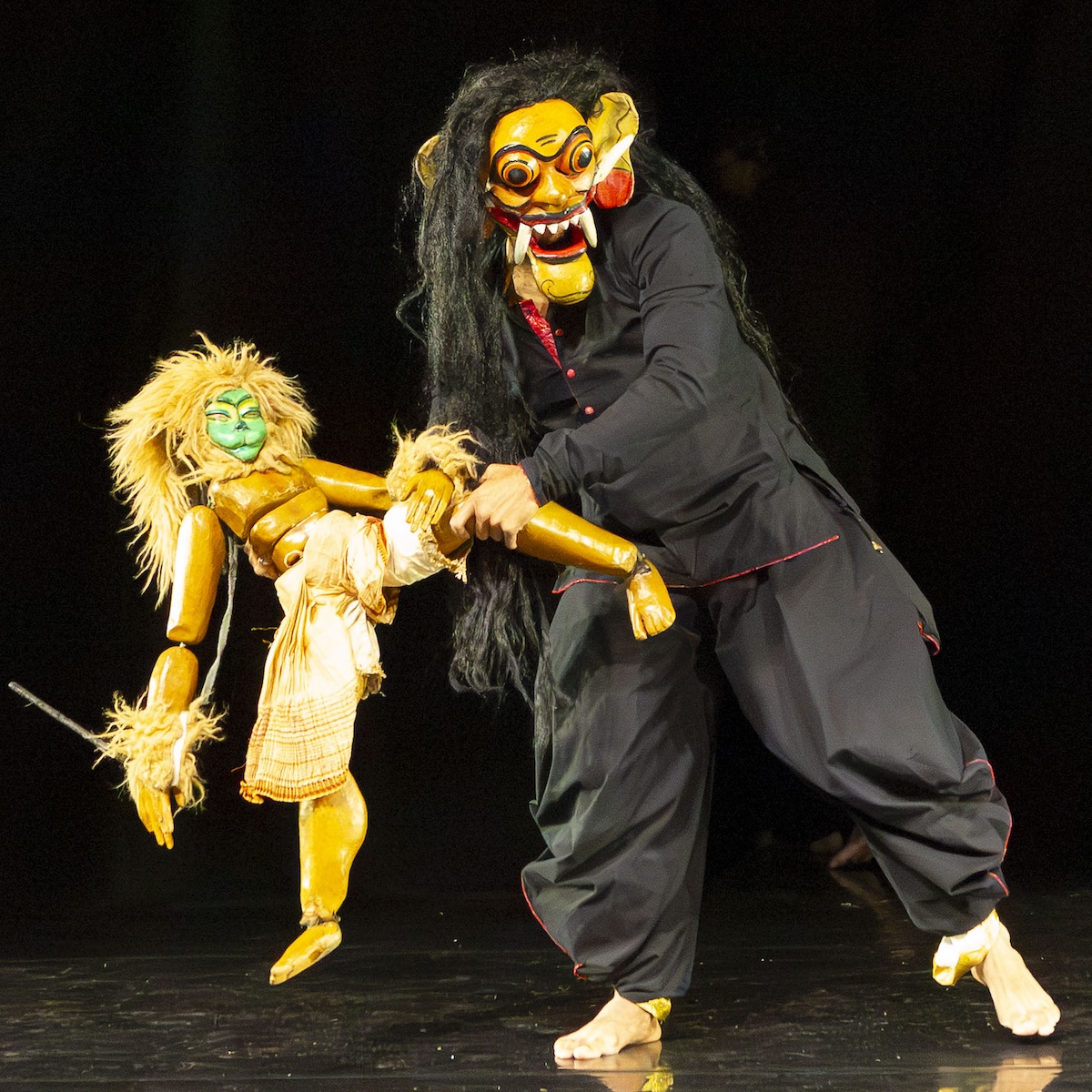
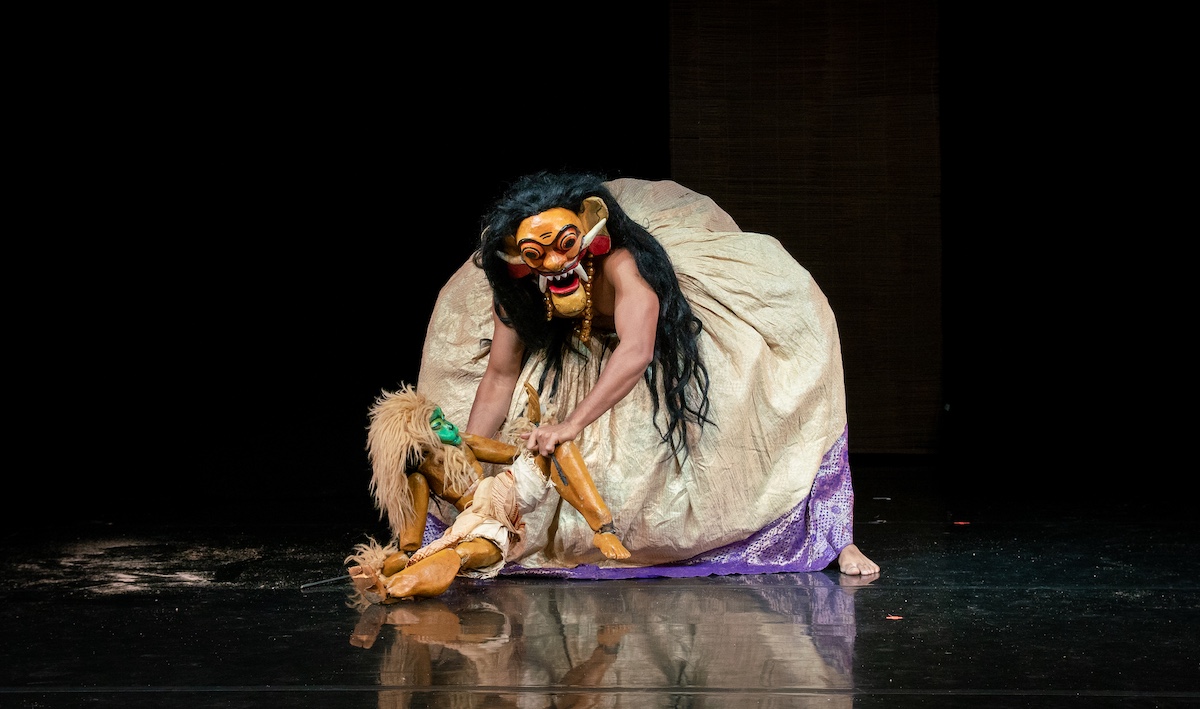
Puppeteer and scholar Matthew Isaacs Cohen observes that, “Examined as a whole, the Ramayana is probably the most popular story source for shadow puppetry throughout South and Southeast Asia” [2023: 231]. This is certainly true of the Indian shadow puppet form, tholpavakoothu, which originated in the southwest state of Kerala, but other traditions from the subcontinent utilizing performing objects also dramatize the story of Sita and Ram. These include the kaavad wooden story box native to Rajasthan in the northwest that literally unfolds their narrative via a series of panels and the full-body mask-puppets of bhaona, performed in ritual spaces on Marjali Island in the northeast of the country. While not drawing upon any of these traditions directly, Anurupa Roy’s production of About Ram for the New Delhi–based Katkatha Puppet Arts Trust reflects the myriad of traditional theatrical containers that have been devised to convey this story by utilizing a different aesthetic language for each of its six sections: brightly colored projections, Bunraku-style puppetry, mask work, Chhau-derived dance,¹ a huge planchette-style puppet, and finally the stillness of an effigy. Eschewing spoken dialogue for the pure visual delight of beautiful objects and the virtuosic physicality of its three core performers (Mohammed Shameen, Avinsh Kumar, and Pawan Waghmare), its melange of styles effectively conveys in a brisk fifty minutes the epic sweep of this tale of an exiled prince, his kidnapped wife, and the war he wages against supernatural forces to be reunited with her. However, this particular love story does not resolve with the narrative satisfaction of boy getting girl back, but rather in an image of his isolation: Ram’s insecurities about her fidelity during their separation create an insurmountable gulf between them, even after her rescue.
One of Ram’s functions in South Asian culture is to serve as an exemplar of the ideal ruler. Staging his story in the context of the present-day sociopolitical situation in India is somewhat charged, as Prime Minister Narendra Modi’s rise to power was inextricably linked to a series of events in a place that was traditionally considered to be the birthplace of Ram. This was the violently contested site of the former Babri Masjid mosque in the city of Adodhya in the state of Gujarat, demolished by a Hindu nationalist mob in 1992. Ten years later, a train carrying Hindu pilgrims home after worshipping there caught fire, killing dozens of people. Rumors spread that local Islamic “terrorists” had orchestrated the tragedy, and in the ensuing riots, it is estimated that nearly two thousand Muslim citizens were massacred. Modi at the time was the chief minister of Gujarat, and it is widely believed that, not only didn’t he do anything to prevent the slaughter, he actively abetted the killings. In 2024 Modi presided over the dedication ceremonies for a new temple to Ram that had been constructed on the site, an event that also served as the kickoff to his reelection campaign, effectively fusing together Hindu religious piety with modern secular power.
Given this fraught political context, I was curious to find out from Roy if the subject matter of the performance made it easier to secure government or religiously affiliated support for the production. In an email exchange she was quite clear that the production was not inspired by religious belief but rather “looks at Ram, the character, as a man and not as a god…India Foundation of the Arts [its sole underwriter] was a perfect partner for the production because they are not a religious organization” [2026, personal communication, February 7]. (This is perhaps unsurprising considering at least one of the performers clearly has a Muslim name.)
While the production may consciously avoid reifying reactionary religious dogma, it nevertheless exudes intense spiritual power. The performance begins in dim light, not with puppets but with the three primary human performers slowly entering the space dressed in traditional black Indian garb. They are accompanied by Abhijeet Bannerjee’s striking sound score combining traditional Indian musical styles, percussive effects like dripping and flowing water, and Western-style strings. Bannerjee’s work will anchor the performance throughout its length, its variegated blend of differing rhythms and instrumental colors firmly anchoring this ancient story in a contemporary, cosmopolitan world.
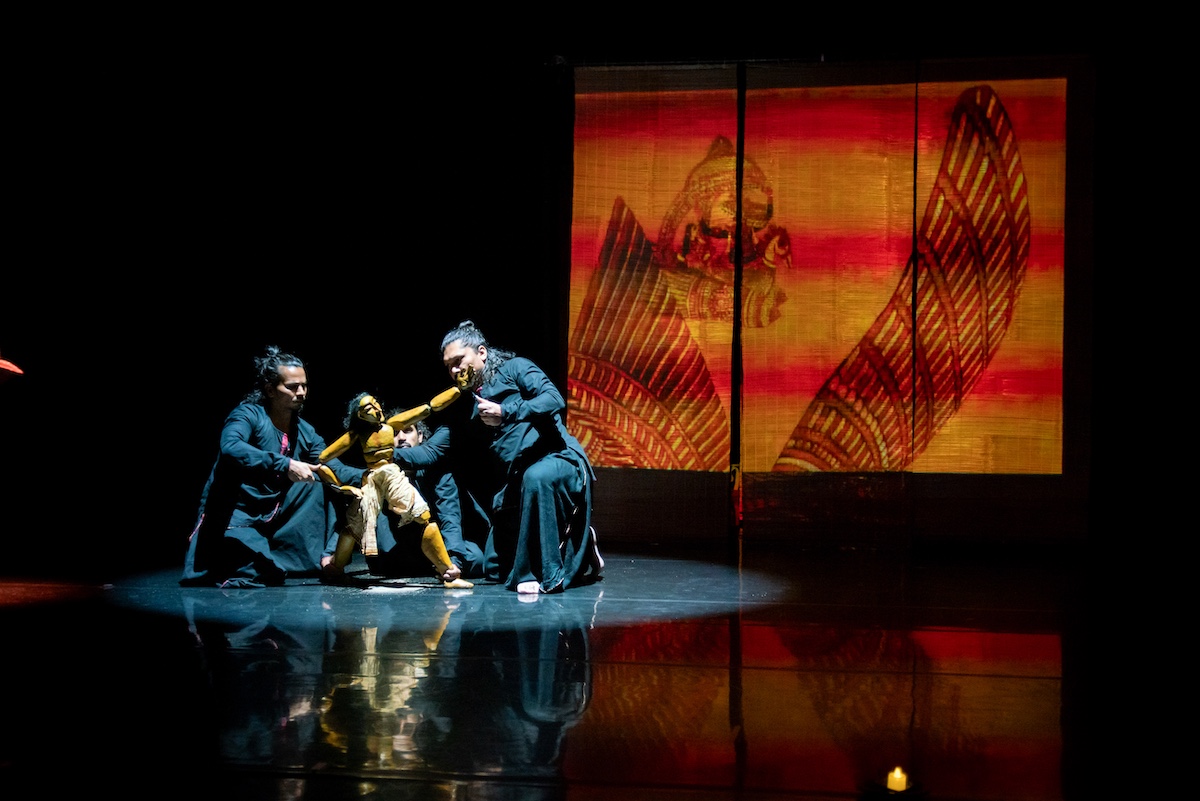
During the opening sequence each man has been assigned his own element to control. The first performer is revealed as the lights come up with his back to the audience, holding a raised candle to the three bamboo screen panels comprising the central section of the set, as if making an offering. He then proceeds to “light” other candles on the stage (actually artificial units). The other two performers slowly enter and cross to baskets suspended from the flies. One pours what looks like sand from his hand into one, while the other does the same with water from a container into the other. The effect is meditative and ritual-like, but the offerings feel to be more about attuning the theatre space itself for the performance than honoring a particular deity.
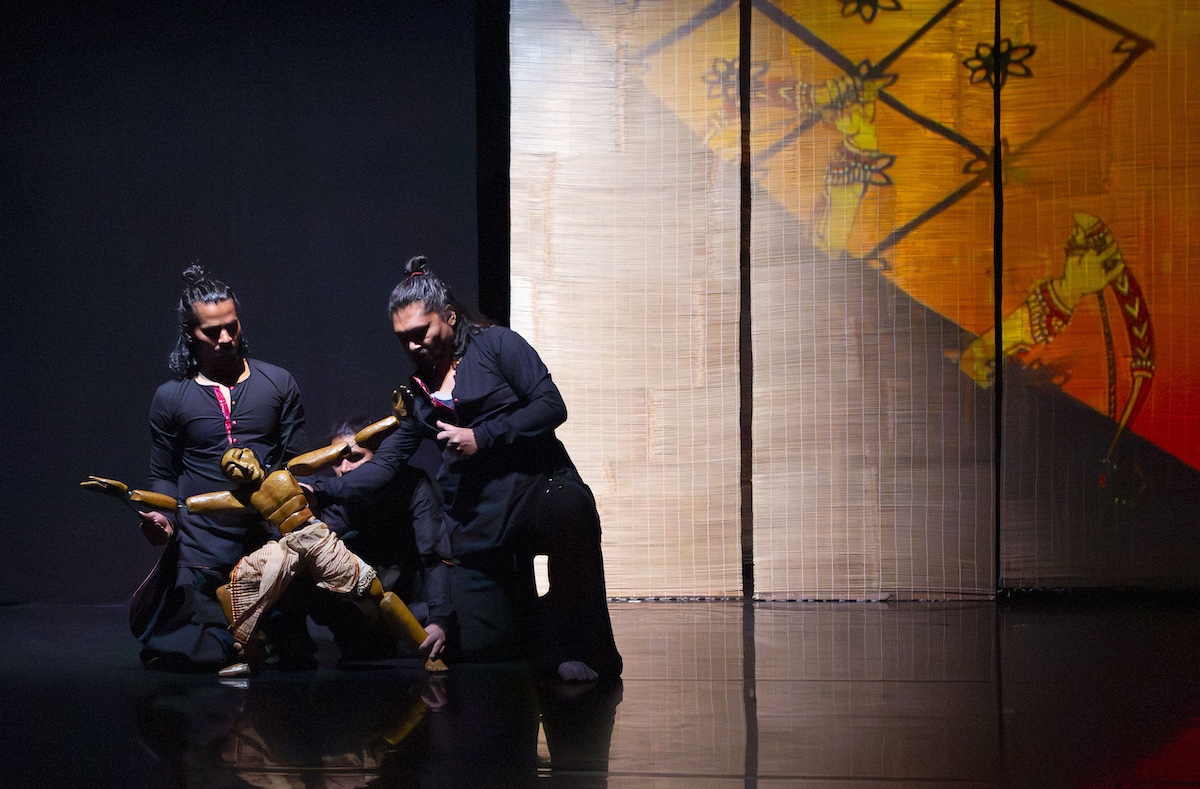
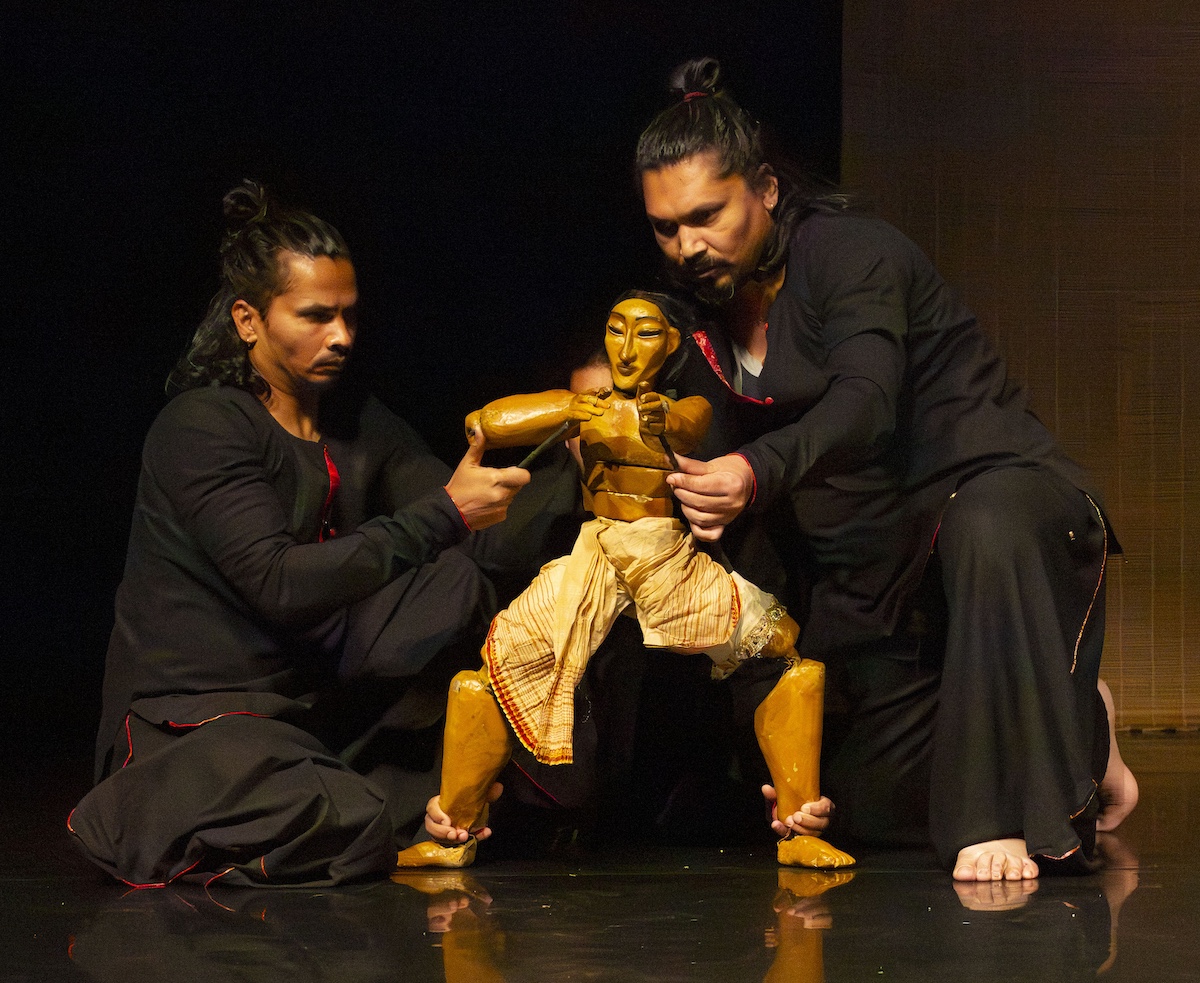
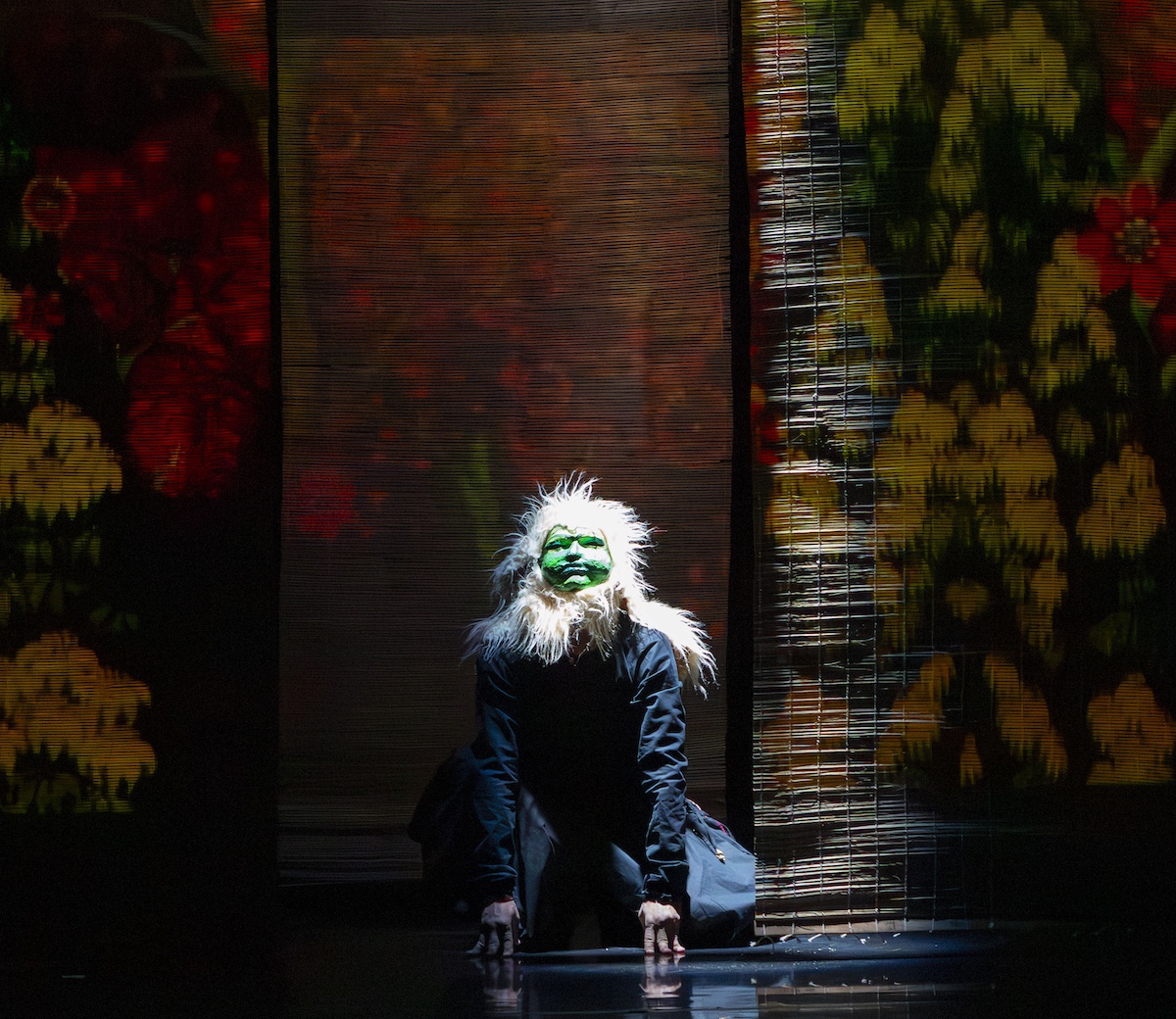
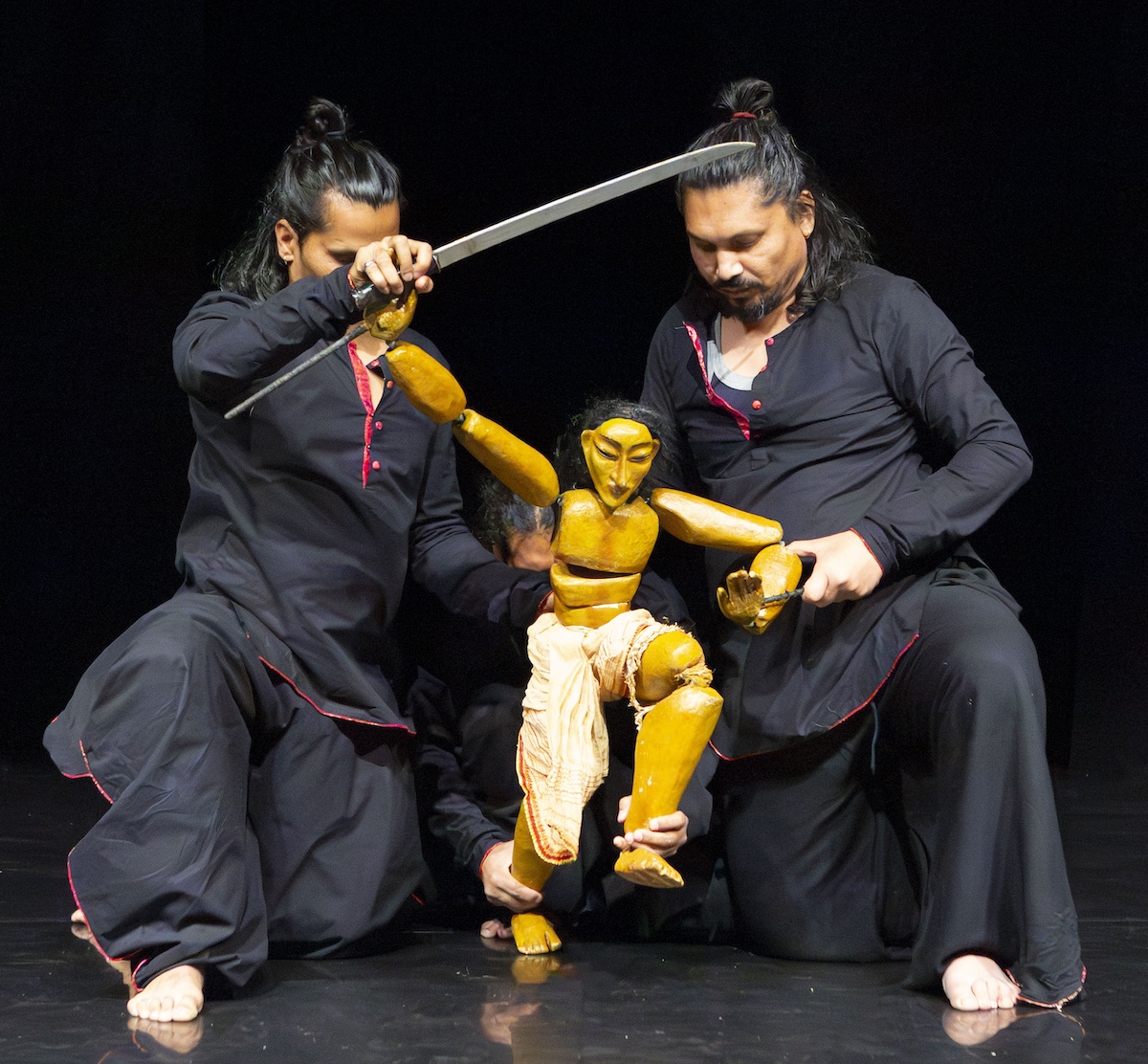
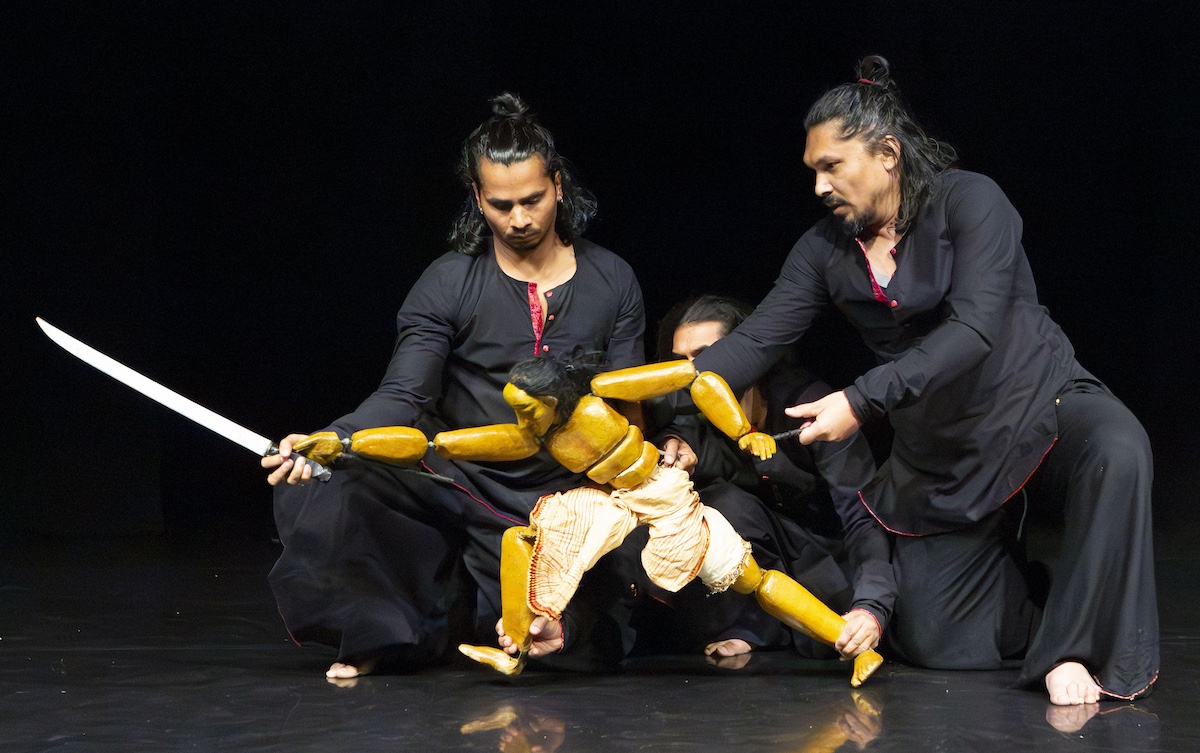
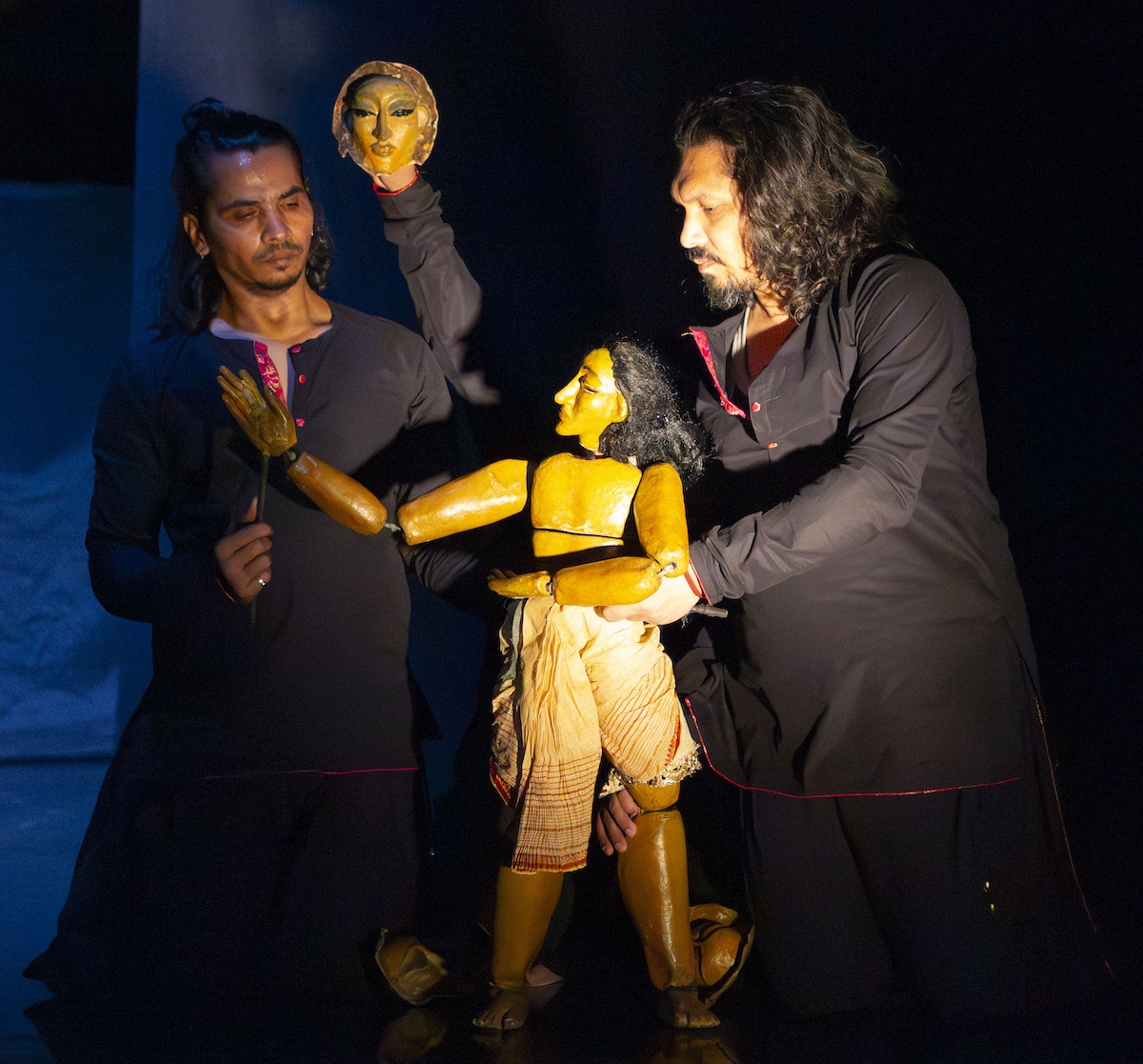
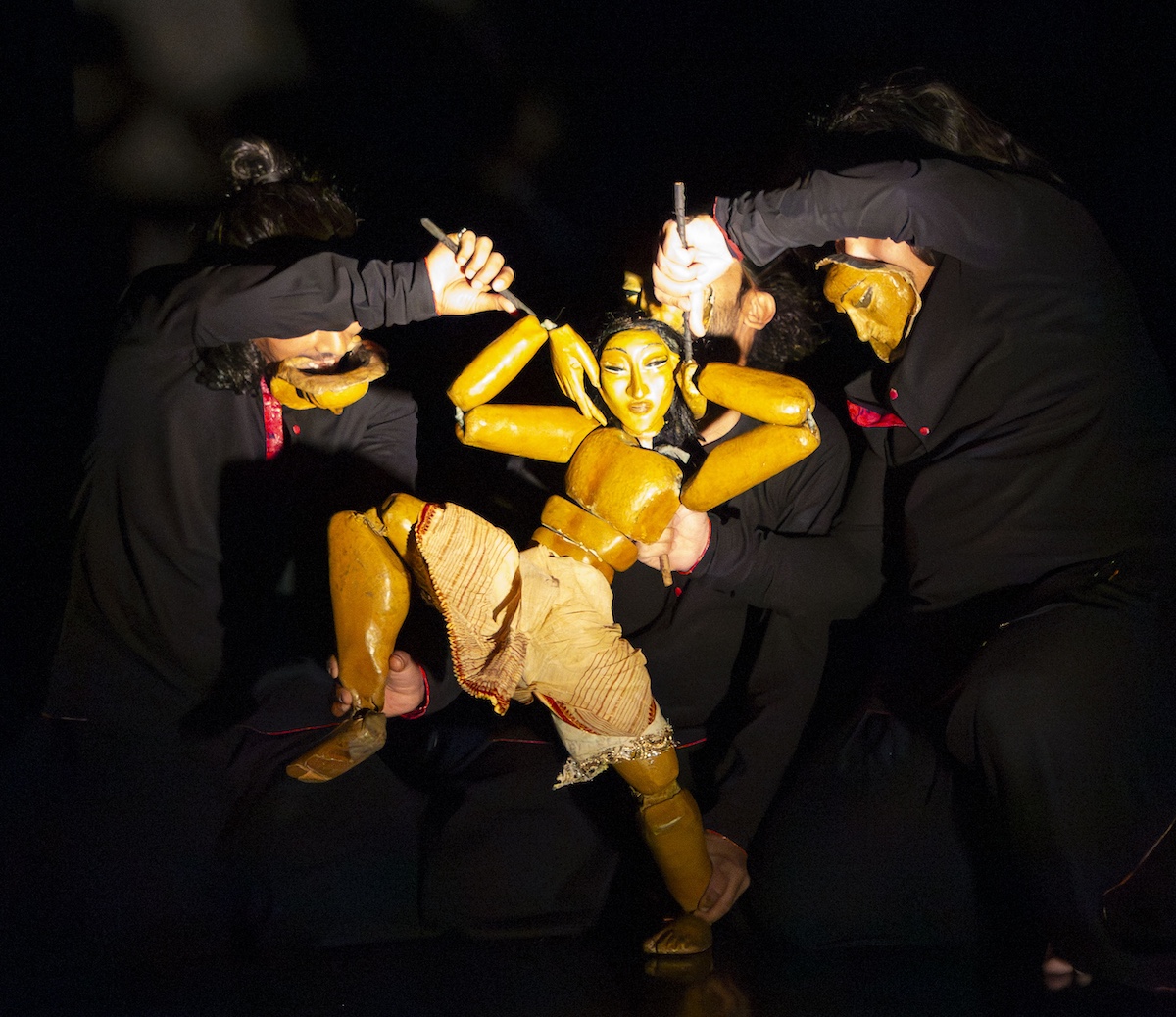
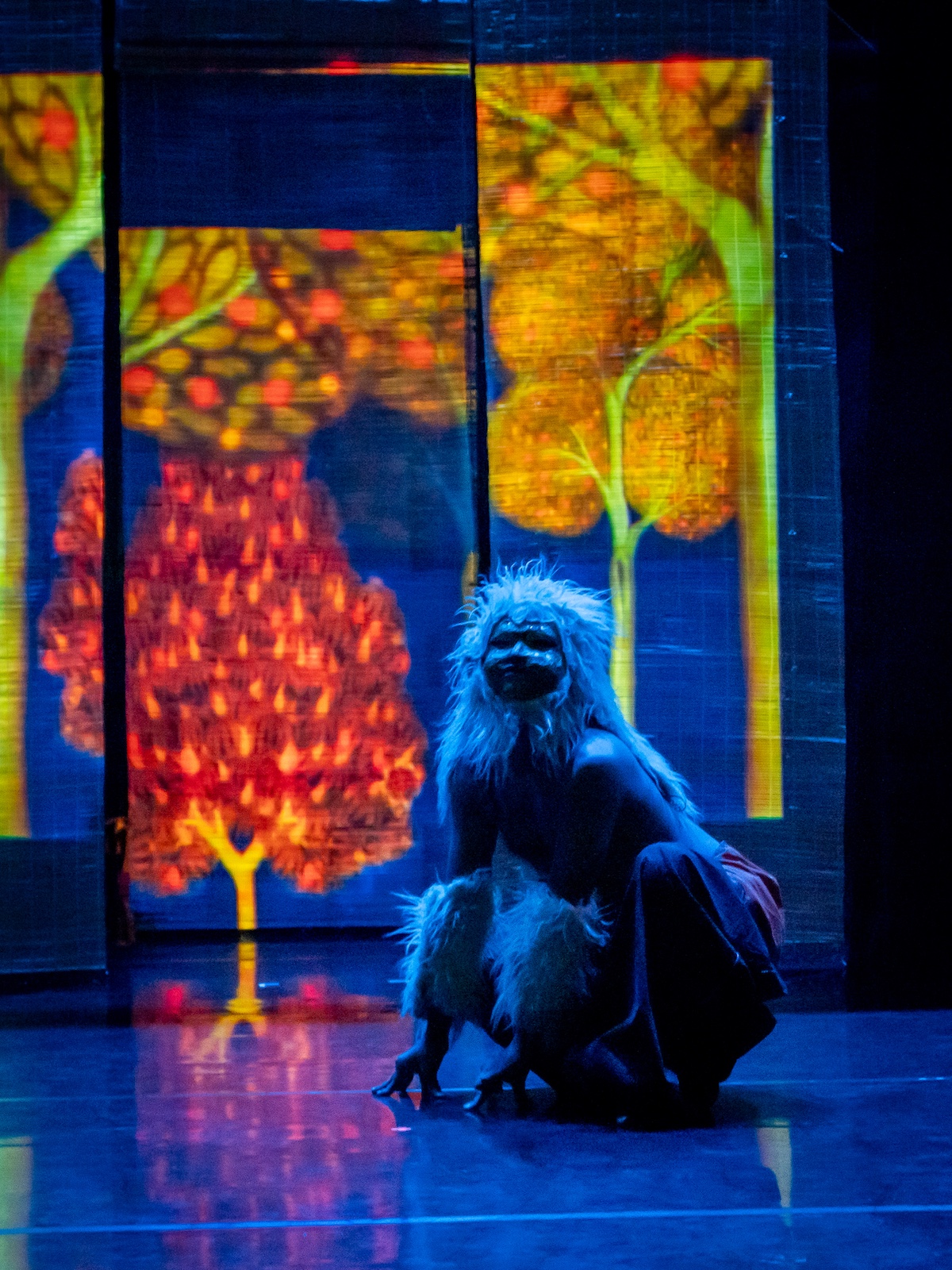
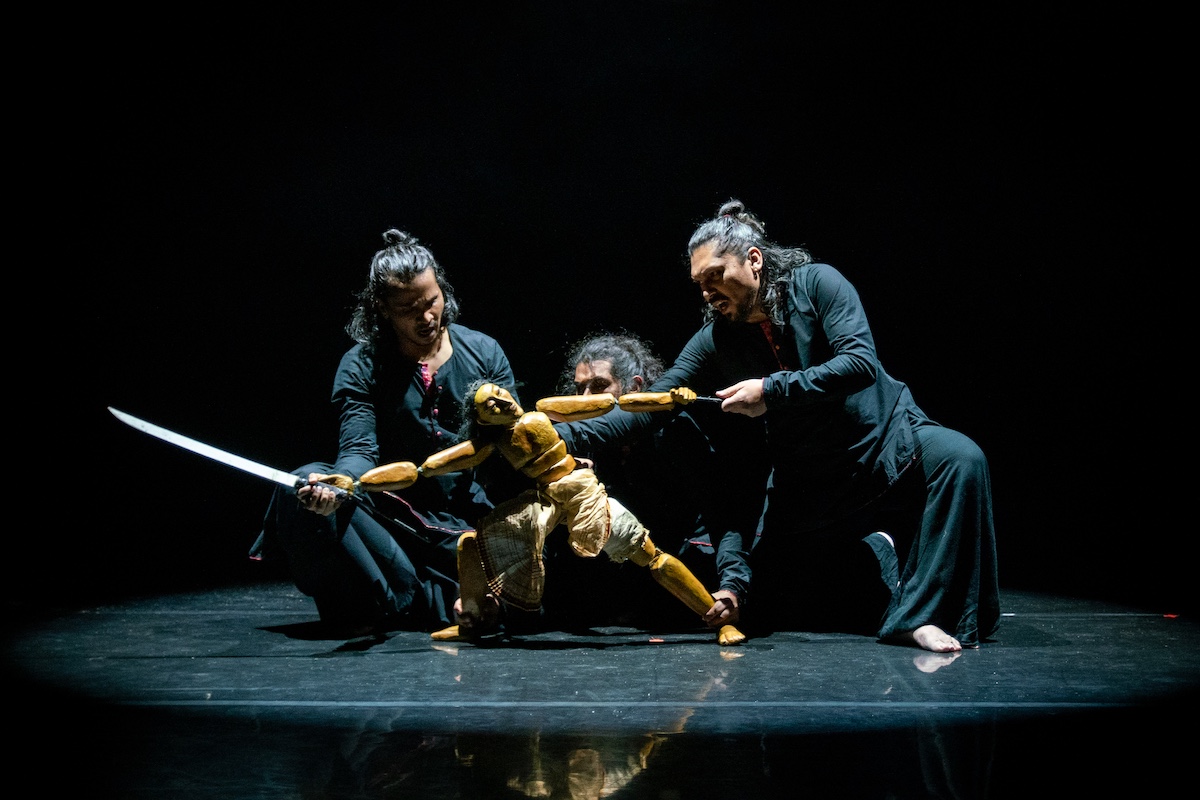
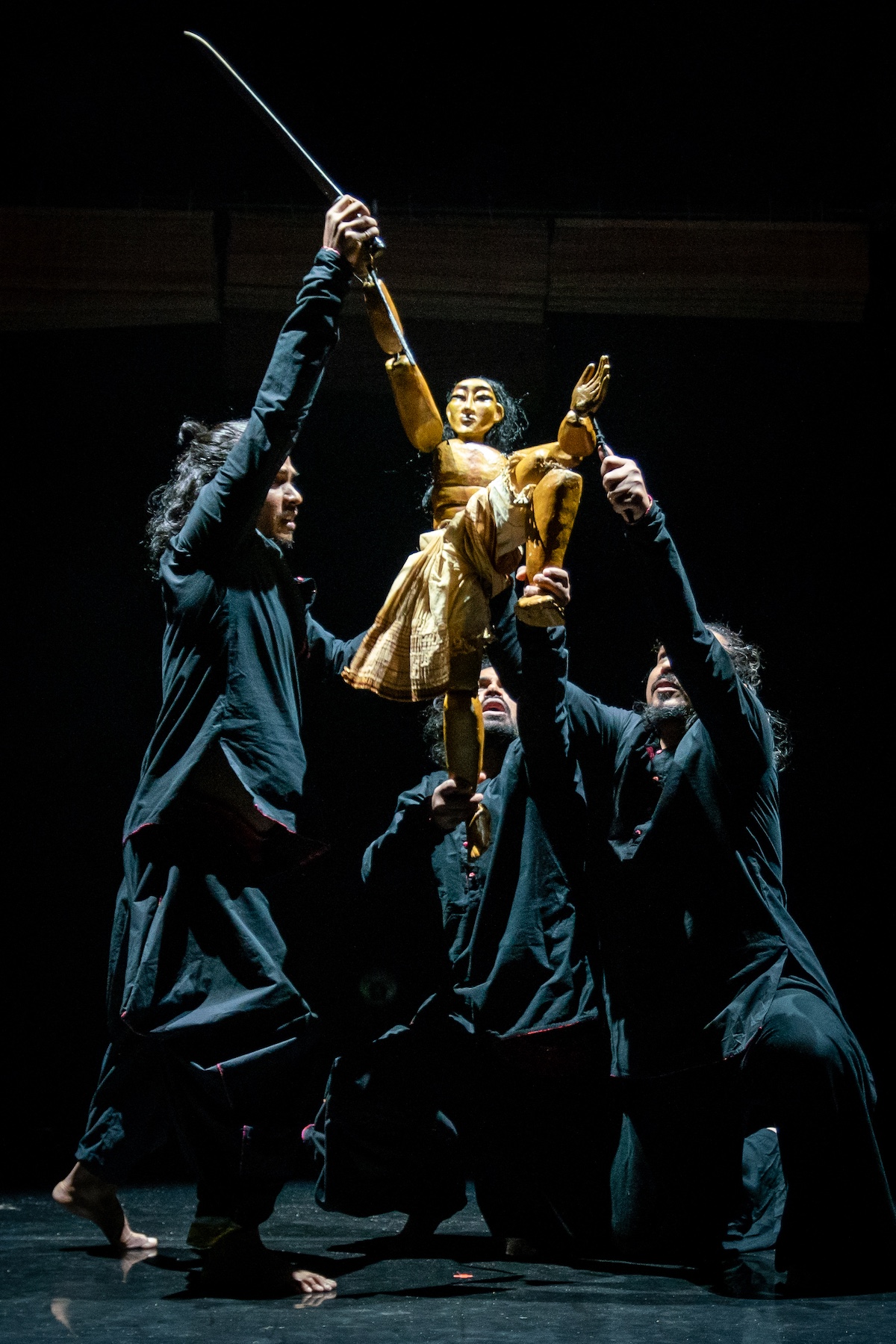
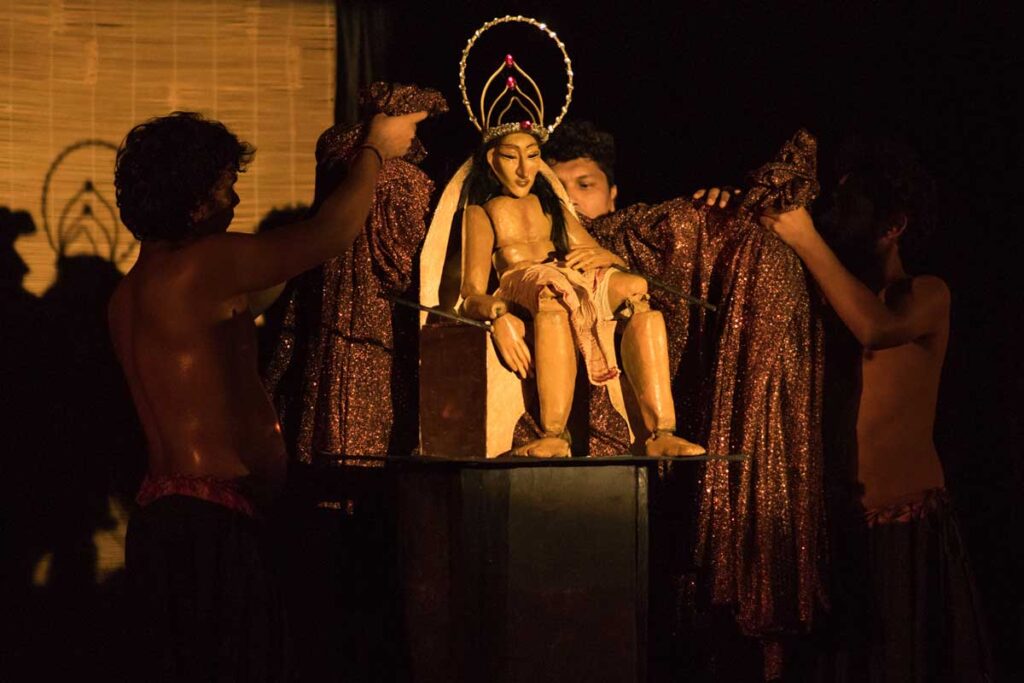
As the light brightens, we notice something covered in a cloth lying onstage. The cloth is whisked off from unseen upstage hands, revealing the prone puppet of Ram. He is bare-chested wearing a white sarong and appears to be carved from wood. The three puppeteers surround him on the floor and begin to bring him to life as a team, bunraku-style. Unlike in the traditional version of this form, their bodies become his stage as the puppet rests on their knees and clambers around their shoulders. He begins to pantomime events from his early life as Vishal K Dar’s animated projections (that look like something out of a children’s picture book) play on the screen behind them. At one point an elaborately painted royal elephant appears walking across the screen (a reference to Ram’s privileged princely upbringing). At the same time, Ram rides on one of the puppeteers, who uses his arm as if it were a trunk.
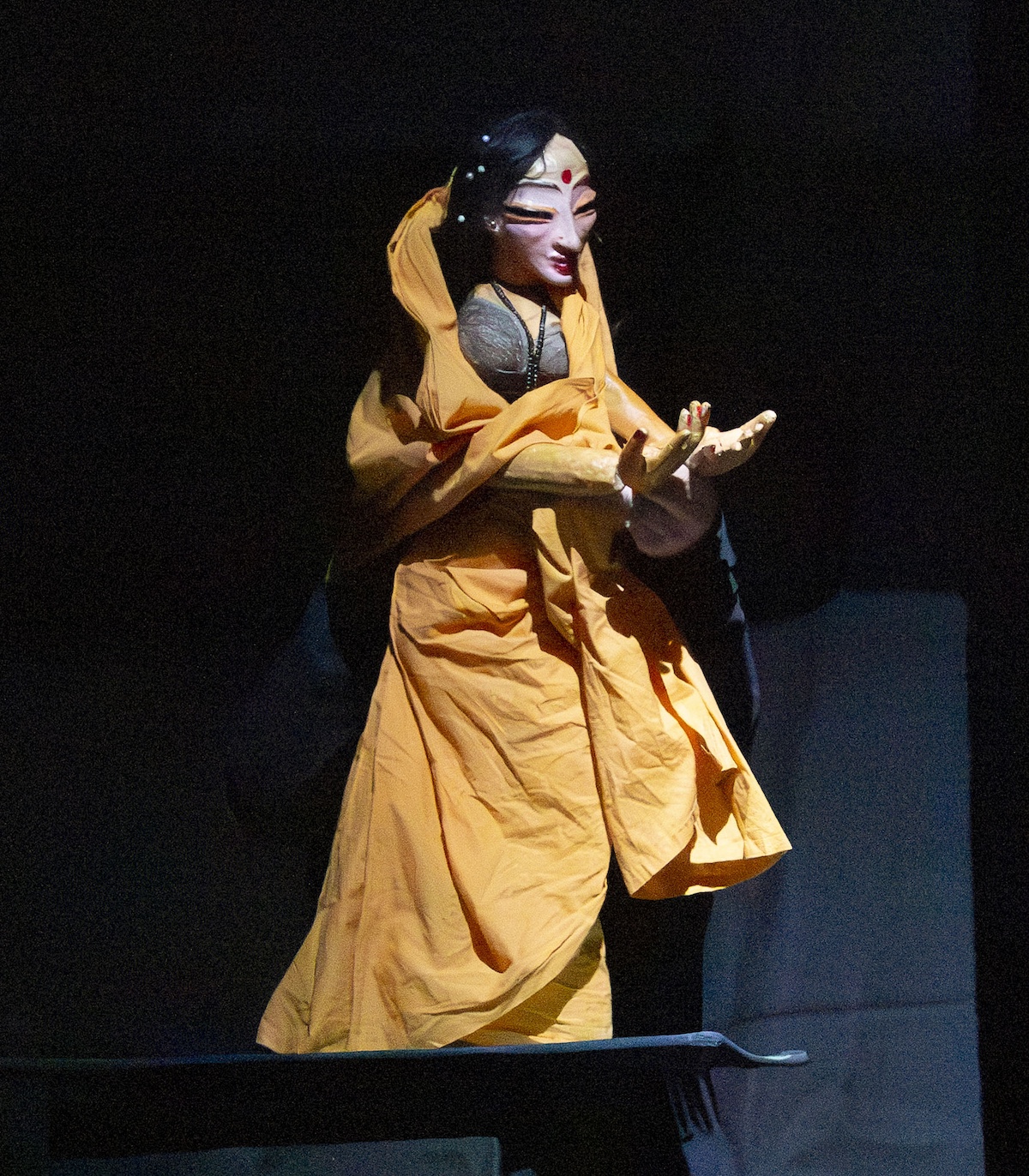
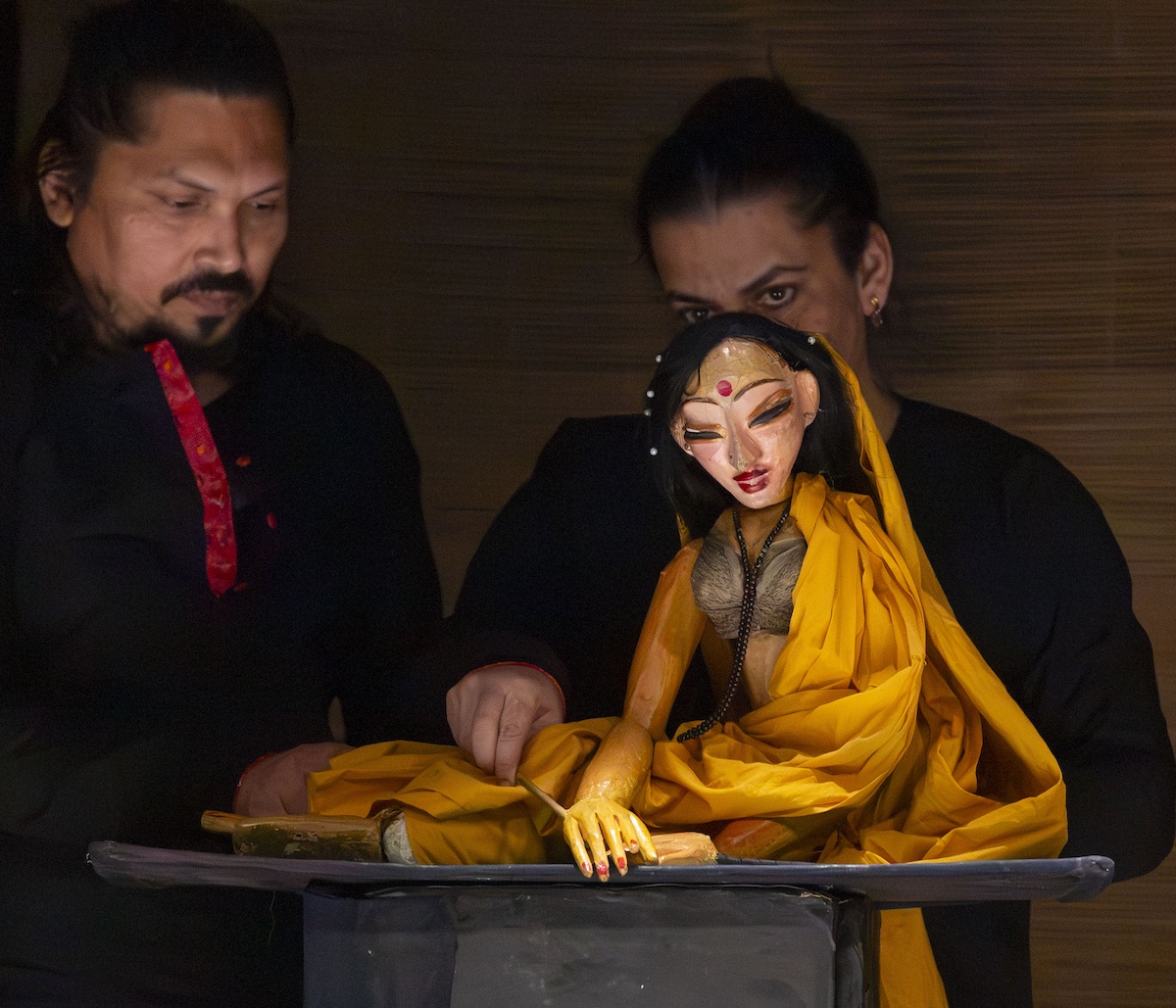
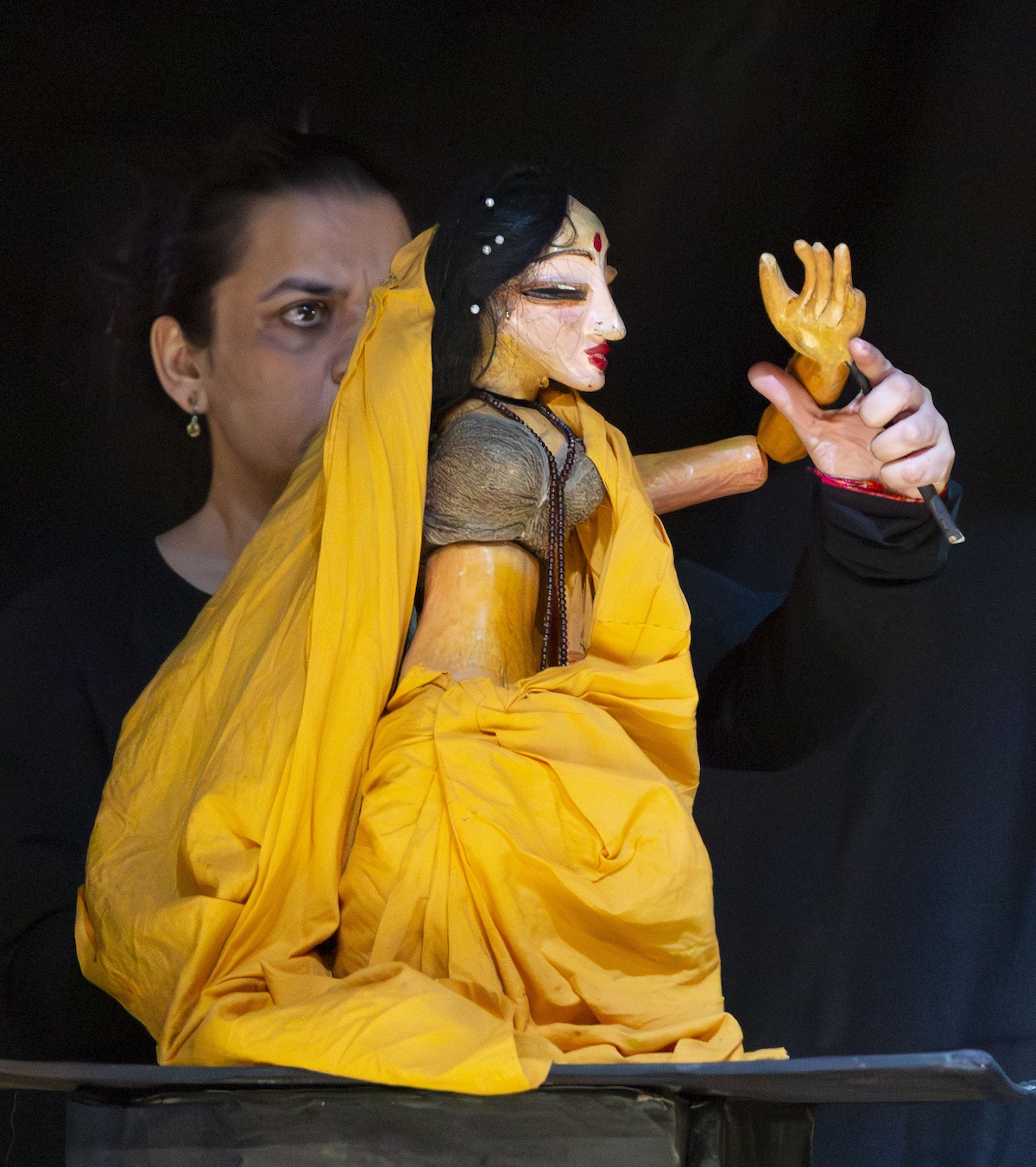
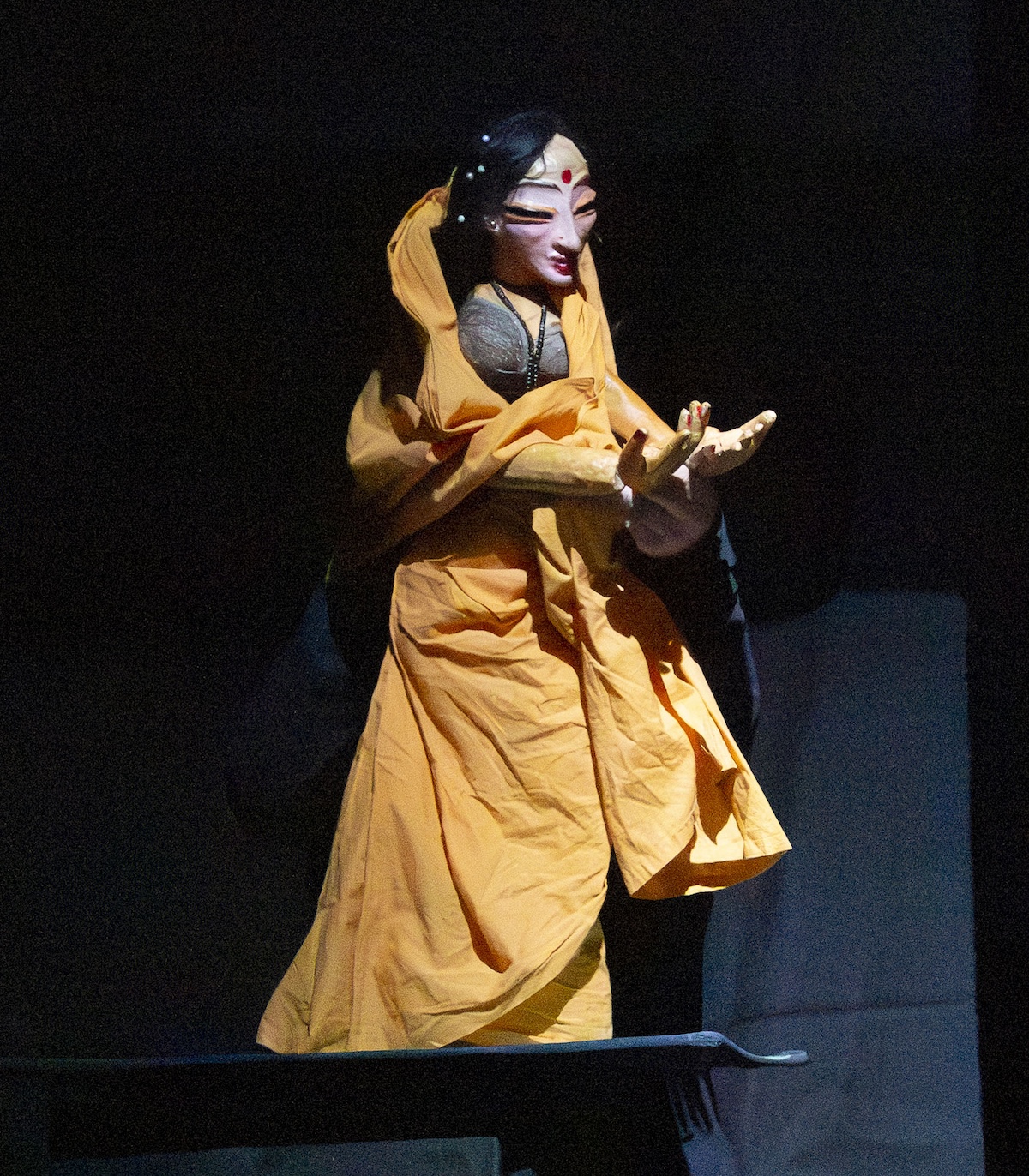
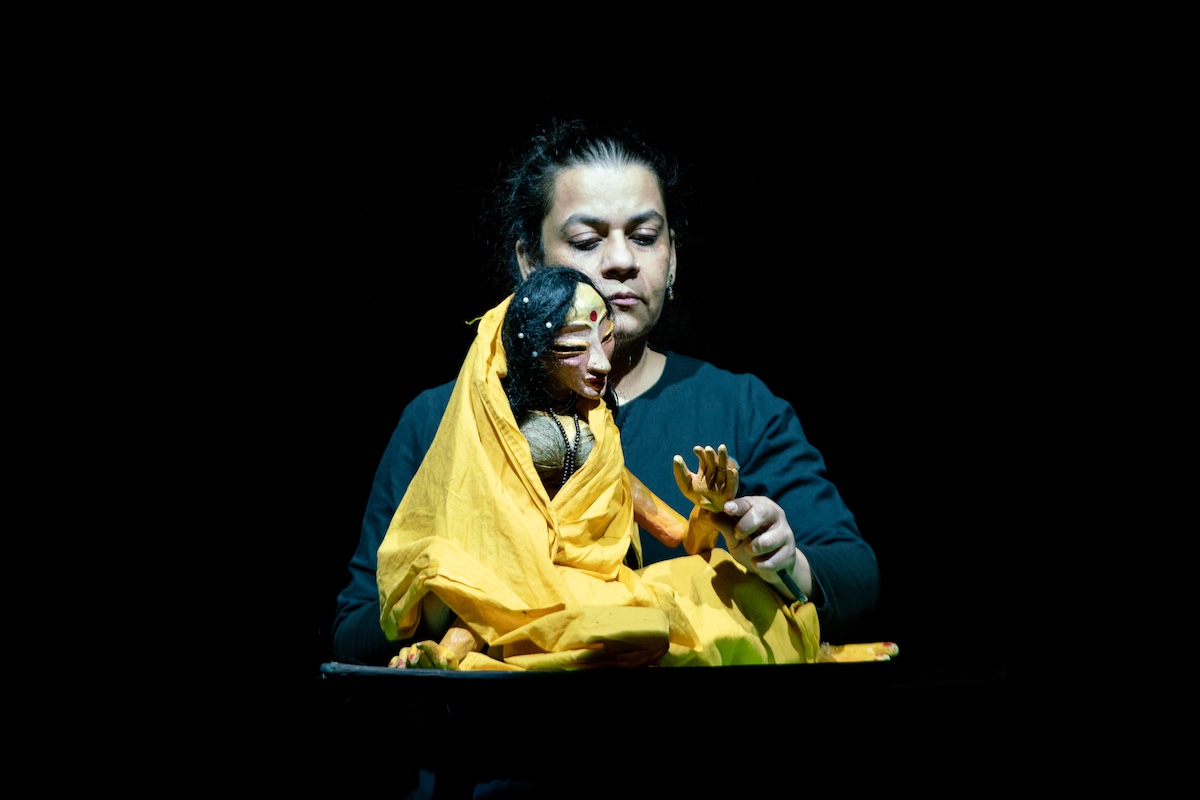
There are moments like this throughout the production when the role of a single character—human, animal, or supernatural—is shared between human and object performers. Ram begins as a puppet, but later he is a human performer wielding a sword. Ravana first appears as a masked Chhau character danced by a human but in the scene with the sword wielding human he is a flat wooden puppet with a spinning head. Sita is a wooden puppet operated by Roy, but then she becomes three masks the same size as her head that each puppeteer, bare chested like Ram and surrounding him, holds in his mouth as he tortures himself with the thought of her possible unfaithfulness with Ravana.
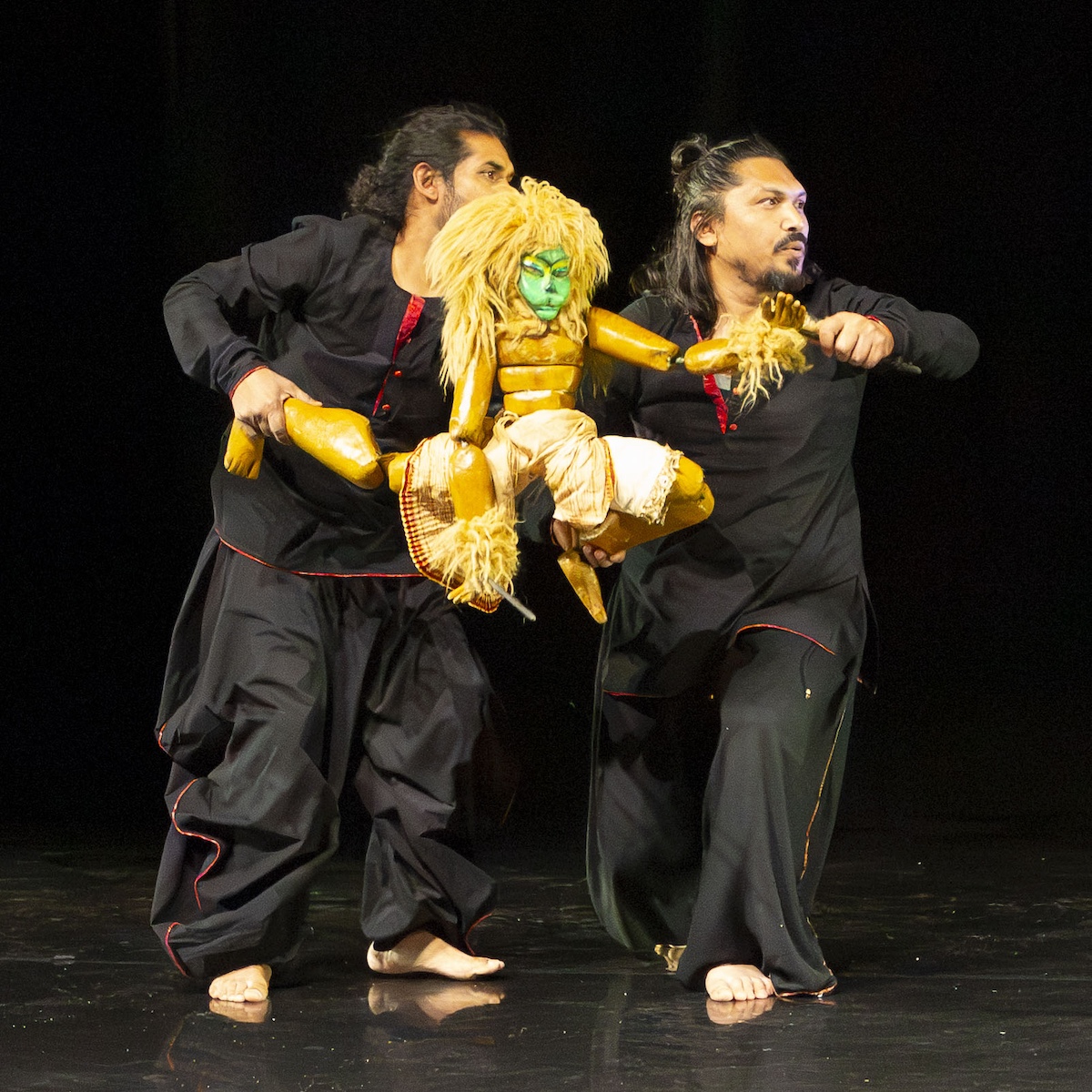
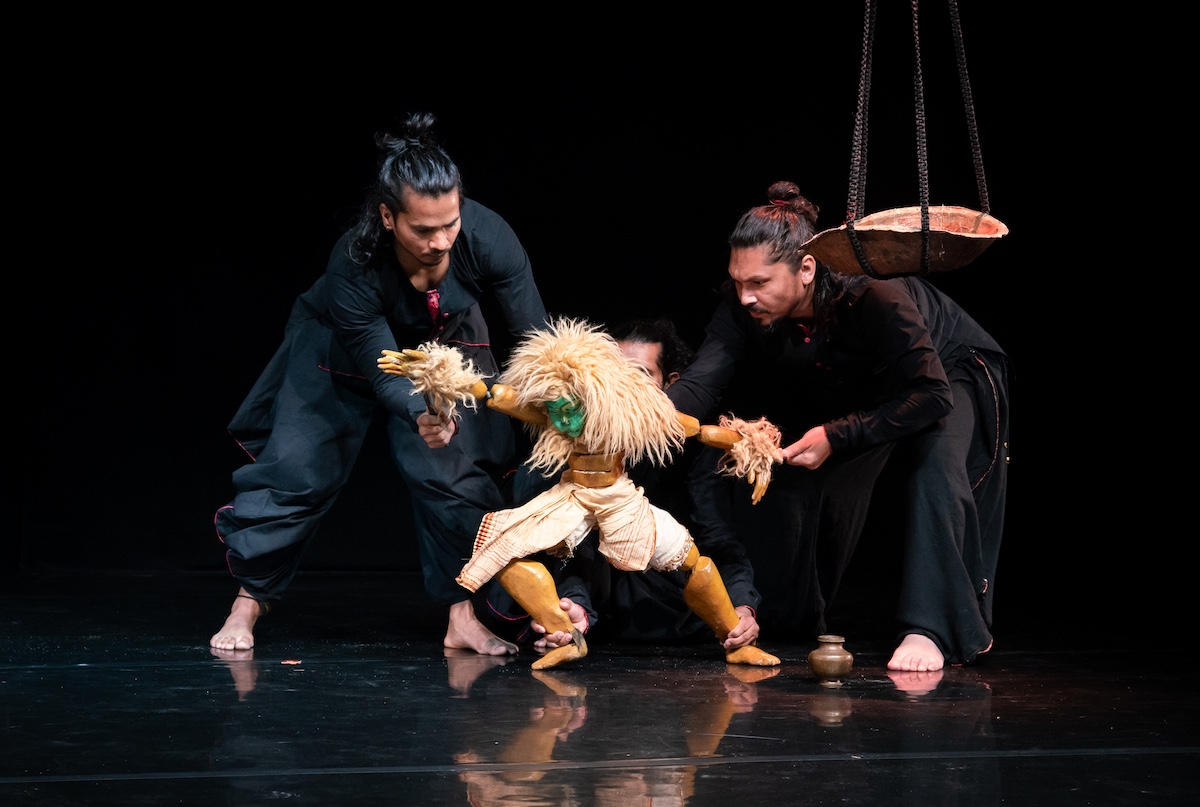
But perhaps the most powerful example of this is with the character of Hanuman. Just as the animated sequence at the beginning of the show finishes, one of the puppeteers breaks away from the others, expertly mimicking the physicality of a primate. He exits, only to return (once more as a human) holding a miniature monkey mask. One of the other puppeteers produces two paws from beneath his costume. For a moment, head and hands form the sketch of an invisible monkey dancing in the air, but then something extraordinary happens: They place these on the puppet of Ram, transforming him into Hanuman. The puppetry that ensues is the most technically intricate and joyously kinetic of the evening, as Hanuman leaps from puppeteer to puppeteer, balances on one arm, and scratches his private parts. He disappears offstage, only to reappear moments later as a one of the human actors in furred monkey mask and arm cuffs. As with the rest of the production, the physicality is both daring and precise as the actor walks on all fours, interacts with the audience, and, yes, scratches his private parts. We eat it up.
While this is all great fun, I also found it philosophically profound. Despite Roy’s insistence that this is a purely secular performance, I can’t help but think of the Hindu concept of reincarnation and the idea that the same consciousness can experience reality through multiple physical forms. The Hindu practice of darshan, or the practice of gazing upon a holy image as a form of spiritual engagement, also comes to mind at the very end of the piece. Ram has finally ascended the throne that is rightfully his, with beautiful sparkling fabric extending from either side, and I am reminded of the religious festivals where images of the gods are paraded through the streets. We look at him for what feels like a very long time. He is no longer moving, but I can still feel the energy of the performance pulsing through his repose.
¹ Chhau is a masked energetic dance style from northeast India that combines martial arts and acrobatics. Roy told me that the performer who enacts this sequence spent a year studying the form.
Works Cited
Bose, Mandakranta. “Introduction,” in The Rāmāyaṅa Revisited, edited by Mandakranta Bose, 3-18. Oxford, UK: Oxford University Press; 2004.
Cohen, Matthew Isaac. “Ramayana and animism in wayang puppet theatre,” AOQU – L’epica e il teatro di figura mnondiale/World Epics and Puppet Theatre 4 no. 2 (2023): 227-247.
Festival Performances
About the Performance
 January 29-31, 2026
Dance Center Columbia College Chicago
About Ram is an experimental theatrical piece using excerpts from the Bhavbhuti Ramayana and told through animation, projected images, dance, masks and puppets. It tells the story of Ram, the prince of Ayodhya is exiled by his father, at the instigation of his step mother. He crosses the river to the forest with his wife Sita and brother Lakshman. Sita is kidnapped by Ravan the king of Lanka and kept prisoner. As Ram sits by the ocean looking at Lanka across its vastness his life flashes by, he feels powerless and dejected as he longs to fly across the ocean to his beloved Sita. The puppeteers help him by projecting his desires into the mask of the super hero Hanuman which attaches itself to Rams face, at once turning him into a super powerful simian who leaps across the ocean and reaches Sita.
In this journey and the bloody war that follows with Ravan, Ram becomes a king, forced to choose between the duty of the throne and the love of his wife.He rules alone for the next 10,000 years.
This adaptation looks at Ram as a human being and not as God. It traces Rams inner journey as a man tormented by his forced separation from his wife Sita. He then fights a fierce battle with the demons to rescue Sita only to be tormented by his own inner demons. Is Sita still pure? Will the people of Ayodhya ever accept her?
About Ram was created with a performance grant from the India Foundation for the Arts and in collaboration with animator Vishal Dar.
Reviews + Interviews
Dispatch: Puppet Theater Festival Ends with Shows Featuring Sexy Puppets, a Hungry Crocodile, a Cat and Two Dogs by Third Coast Review Staff for Third Coast Review (About Ram review by Adam Kaz)
8th Annual Puppetfest Warms the City by Angela Allyn for Chicago Stage and Screen