2026 Festival Archive: Théâtre de la Massue and Chef Chris Sullivan
Théâtre de la Massue: La Méridienne / Chef Chris Sullivan of Twilight Kitchen
January 22-28, 2026
Private Wicker Park Location
Presented by Chicago International Puppet Theater Festival
With support from French Institute in Chicago
Scholarship and Resources
Eternity in an Hour: La Méridienne Ponders the Beauty and Brevity of Existence
An Essay by Jesse Njus
The phrase “dinner theater” may conjure images of an entertaining evening, but most people would not anticipate a night of haute cuisine combined with a spectacle of extraordinary delicacy and philosophical introspection. Drawing its title from the French term for an afternoon siesta, La Méridienne is a remarkable dinner theater presentation created and performed by Ézéquiel Garcia-Romeu (the artistic director of Théâtre de la Massue) alongside three colleagues: a host, a guide, and a chef (Chris Sullivan of Twilight Kitchen during the 2026 Chicago International Puppet Theater Festival). Mealtime entertainment has existed for millennia; Homer metatheatrically describes Odysseus sobbing during a banquet upon hearing a minstrel sing about the Trojan War. Yet even within such an extensive history, La Méridienne is unusual.
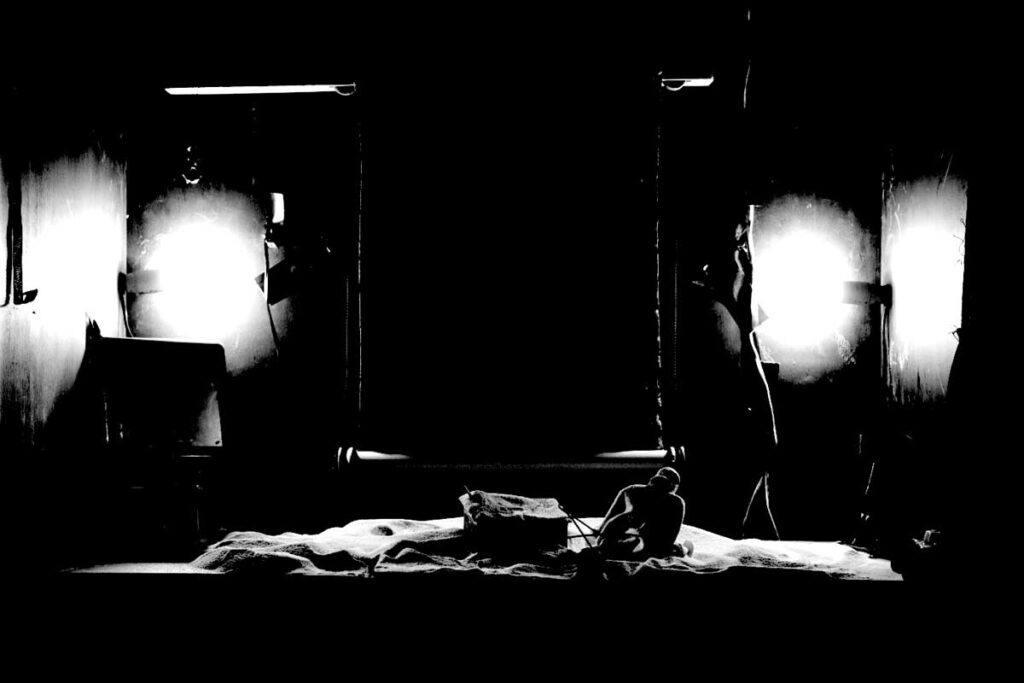
The concept of La Méridienne encompasses the entirety of the event: a dinner for twelve people, prepared by an accomplished chef, during which each individual is tapped on the shoulder and guided—one by one—to a unique five-minute performance. The production, like the afternoon practice for which it is named, is ritualistic. Breaking bread and watching a play are traditionally both communal rituals, but La Méridienne’s shared repast is interrupted by a solo viewing of the puppet show, an oasis of personal reflection surrounded by the conversation of the meal. When tapped on the shoulder, each guest is taken to a waiting area where the guide explains the procedure and then leaves the viewer alone to sit in a chair under an intense light, surrounded by black drapery. Resting under a dazzling light encourages the patron to think about the nature of drama and the artificial separation between performer and audience. Several participants agreed that being seated in the blinding glare felt interrogative, as though one was being watched and perhaps judged. After a few minutes, a curtain pulls back, and the previous spectator rises from their seat, leaves the room, and the new onlooker walks in and takes a seat. Everything is shrouded in darkness and black curtains, and a dark black box stage (quite literally the size of a small box) rests directly in front of the observer. A screen rises, and an even smaller interior black box stage is illuminated.
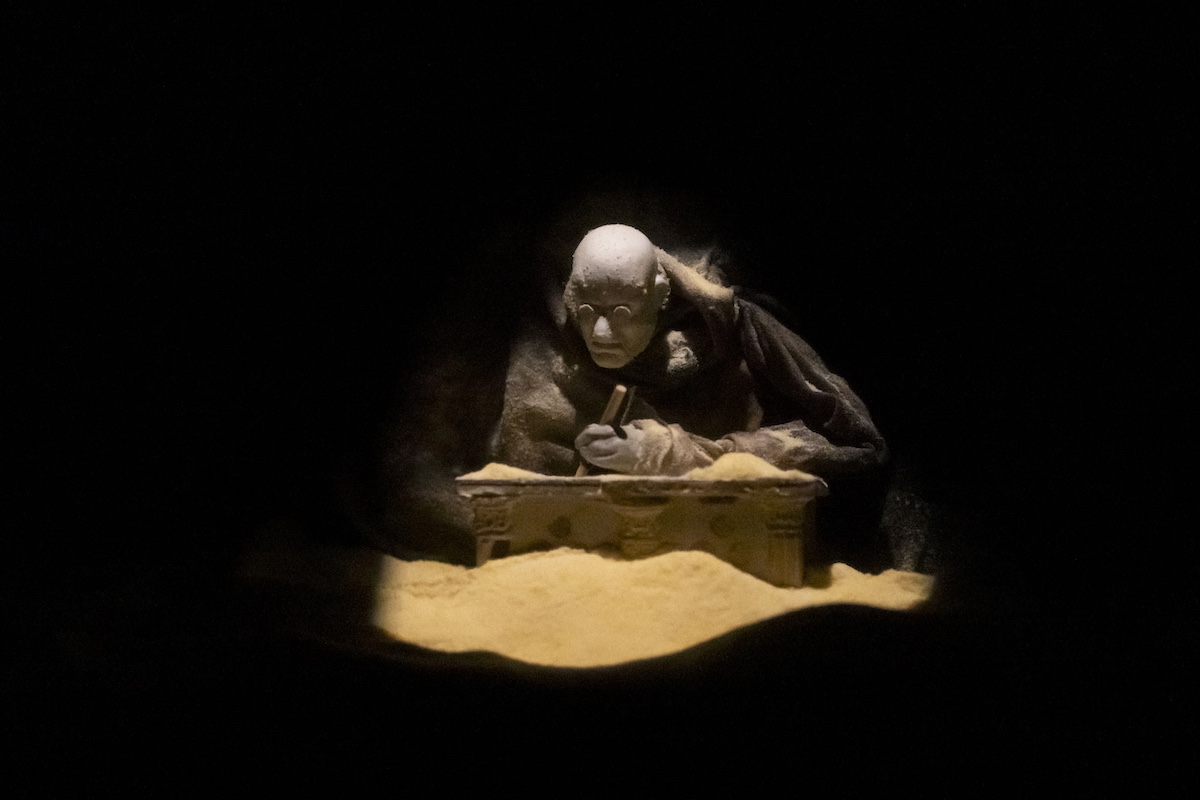
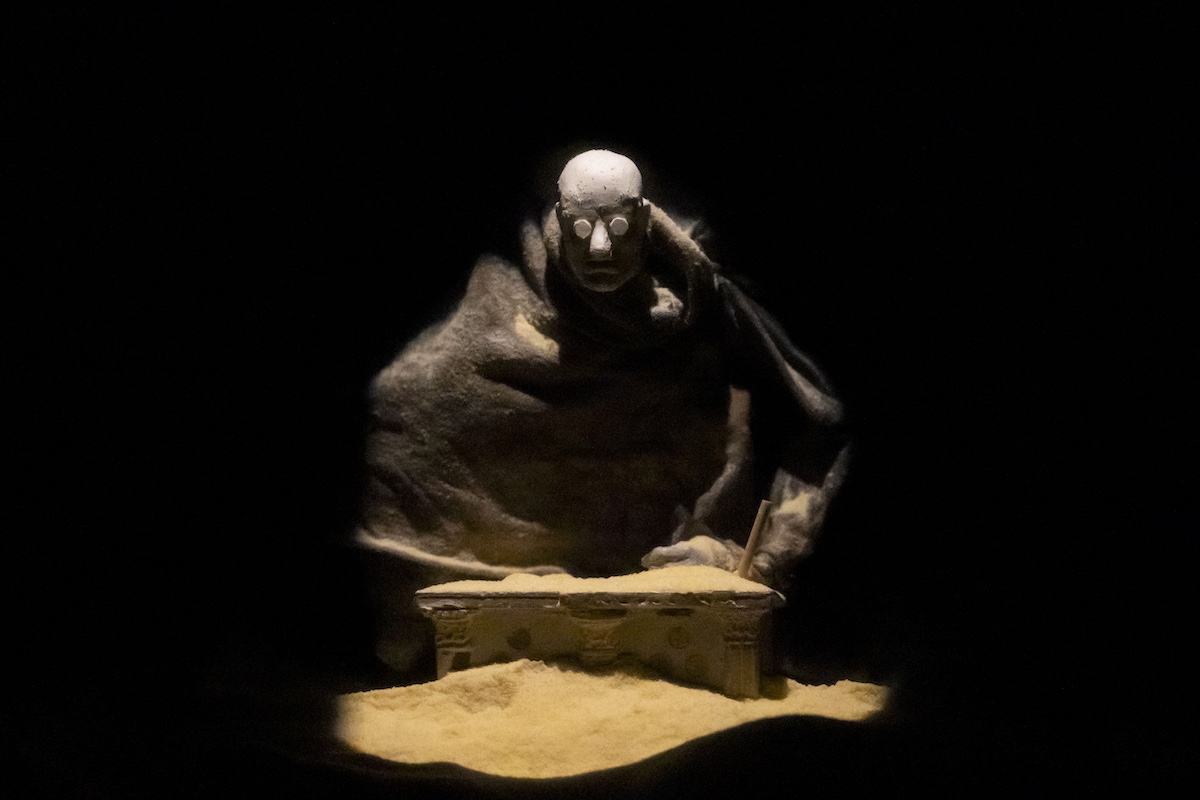
The brief scene that unfolds over only five minutes is a beautiful meditation on the human struggle to exist. A small gray puppet, who appears almost made of stone, rises from the sand. Wearily (puppets by their nature struggle to exist), he pushes the sand from his table and attempts to write. He writes in the sand, looks at his words, and then repeats the ritual—writing, scrutinizing, and pondering. Eventually, he stops and puts down his stick. A human hand suddenly descends and writes in the sand. The puppet looks at the words and up at the hand. The hand moves the sand and then pours sand on the puppet. The puppet collapses. The hand pours sand over the puppet as the floor with the puppet sinks and the lights go down. The screen comes down in front of the box, the curtain opens, and the viewer rises and departs as the next spectator enters.
The only instruction provided to the entire audience at the beginning of the dinner was to refrain from discussing the piece until everyone had an opportunity to experience it. The meal was delicious, and Chef Sullivan created a calm and festive atmosphere that took food preferences and allergies into account as he decided on the specifics of each course. The guests at the showing I attended were roughly half puppeteers and half Chicagoans who were simply interested in this singular offering from the festival. The conversation roamed around topics germane to the festival—puppetry, art, and theater—as well as the history of the festival and its past performances. The group dynamic was that of a warm dinner party with friends, a collegiality that was emphasized by the fact that everyone was participating in an event that was simultaneously shared and solitary. A kinship grew every time someone returned from the play, knowing—even without mentioning it—that there was a shared understanding that had not previously existed.
The post-show discussion was—both literally and figuratively—the dessert course. A translator was ordinarily provided for guests who did not speak French, but at the viewing I attended there was no available translator, so we spoke directly to Garcia-Romeu (whose English did not seem to require a translator). I am glad that we were able to speak to the creator without an intermediary, since in many ways the puppet was the intermediary between Garcia-Romeu and the observers, and it was lovely to create a direct connection.
The puppet’s performance seemed so magical that the onlookers had extremely diverse opinions concerning the nature of the puppet and the material from which it was made. When Garcia-Romeu explained that it was a rod puppet made of clay, several people were surprised. The puppet’s face was immobile but—like a mask worn by an experienced performer—the expression seemed to change as it moved in the light. Many guests asked about the possible religious significance, having deduced that the puppet may have been a prophet or a messenger. Garcia-Romeu hinted that the reason for the twelve spectators was a connection to the twelve apostles at the Last Supper, yet he also stressed that the production motif was not solely—or even primarily—religious. He suggested that the play contains three acts—the birth, life, and death of an individual, or perhaps the rise, development, and collapse of a civilization. According to Garcia-Romeu, the puppet is conscious of the viewers watching him, and the hand that appears represents the hand of Time, reminding the audience (and the puppet) that time passes but that there is a force outside of time that represents eternity. Watching the puppet rise from the sand implies that he is dust, and to dust he returns at the end. Nonetheless, the clearer parallel is William Blake’s circa 1803 poem “Auguries of Innocence” (first published in 1863), where he ponders the ability “To see a world in a grain of sand/And a heaven in a wild flower,/Hold infinity in the palm of your hand/And eternity in an hour.” To depict the passage of humanity or civilization in the span of five minutes is a notable achievement.
The meditation on existence generated by this distinctive gathering—a fascinatingly experimental theatrical format—is made possible by the sponsorship of the Musée Culvet, which was a coproducer. Housed in an eighteenth-century mansion in Avignon, the Musée Culvet began as the collection of Esprit Calvet and today also serves as one location for the summer theater festival in Avignon. The Théâtre de la Massue is also sponsored by a variety of regional government organizations (the Provence-Alpes-Côte d’Azur Regional Department of Cultural Affairs (DRAC), Région Sud: Provence-Alpes-Côte d’Azur, le Département des Alpes-Maritimes, and the city of Nice). Ideally, museums promote art for art’s sake, while governmental subsidies similarly enable the creation of work that may not be commercially feasible. La Méridienne is presumably viable, yet the ability to develop such a uniquely contemplative work—one which elevates a form of theater that is frequently considered inferior—is the result of funding sources that do not expect a monetary return on their investment.
The ritual of the spectacle, like the ritual of a dinner party, was an extraordinary experience. There is something remarkable about participating in a presentation that seems so unparalleled and yet partakes of a tradition of banquet theater that is thousands of years old. The production is, in fact, a ritual nestled within a ritual—a discrete performance ritual, reenacted twelve times, encompassed by the supper ritual. Over the course of one hour, the onlookers form a community that extends far beyond the traditional bonds of a theater audience. Spectators also watch the puppet move through a ritual of life and death (on a human level) and of development and collapse (on a societal level), raising the question of where we as individuals—and as a society—currently stand in that cycle. As Blake states in the closing lines of his poem, “God appears and God is light/To those poor souls who dwell in night,/But does a human form display/To those who dwell in realms of day.” The unity of the guests is a reminder of fellowship—the puppet would be alone, its existence unwitnessed and meaningless, if not for the viewer, just as we would be alone if not for our fellow observers. In the end, the encounter is arguably profoundly hopeful—we bear witness and thus give existence meaning.
Festival Performances
About the Performance
 January 22-28, 2026
Private Wicker Park Location
Don’t miss this unique dining and puppet experience. A farm-to-table, family-style dinner for 12 people, pairs with a five-minute puppet show, La Méridienne. The event begins as guests take their seats in a beautfiul, private, chef’s kitchen for a delicious, multi-course meal created by Chicago chef Chris Sullivan, owner of Twilight Kitchen. One by one, each dinner guest is taken into another room for a private viewing of the puppet play which illuminates the human experience over time. The puppet showman, invisible and tucked away in his theater, shares with his viewer a vision of humanity, slipping away like a dream, back to the universe.
Reviews + Interviews
Coming Soon