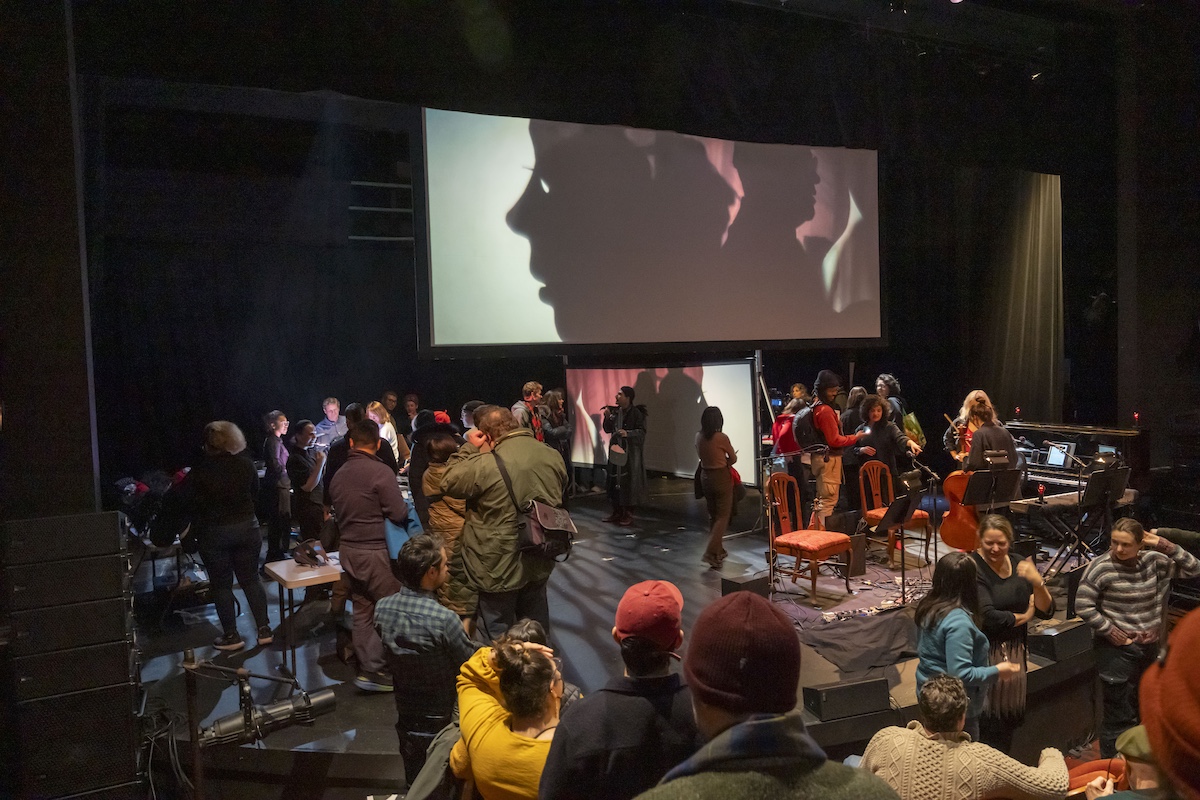
2026 Festival Archive: Manual Cinema
Manual Cinema:
The 4th Witch
January 22-25, 2026
The Biograph’s Začek McVay Theater Mainstage
Presented by Chicago International Puppet Theater Festival
Scholarship and Resources
“When Shall We Three Meet Again?”:
Manual Cinema’s The 4th Witch Reminds Us That Sometimes a Witch Is Simply a Woman Having Feelings
An Essay by Jesse Njus
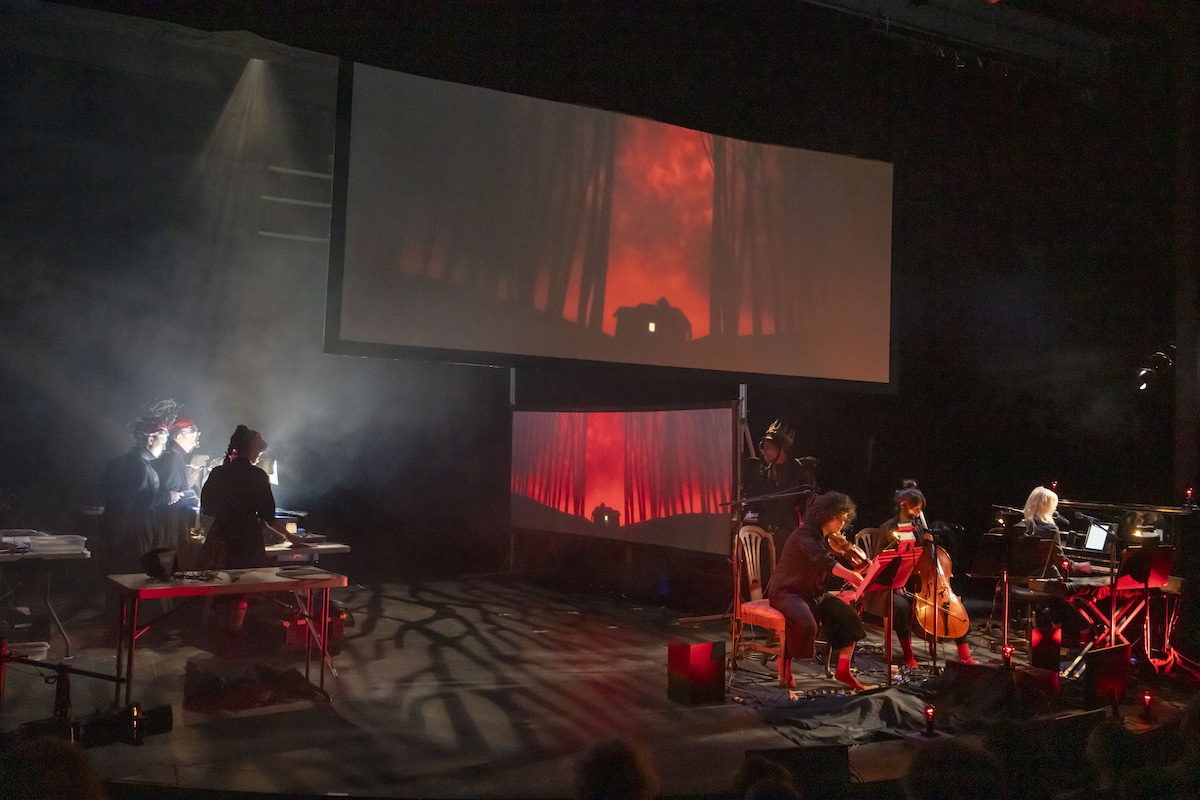
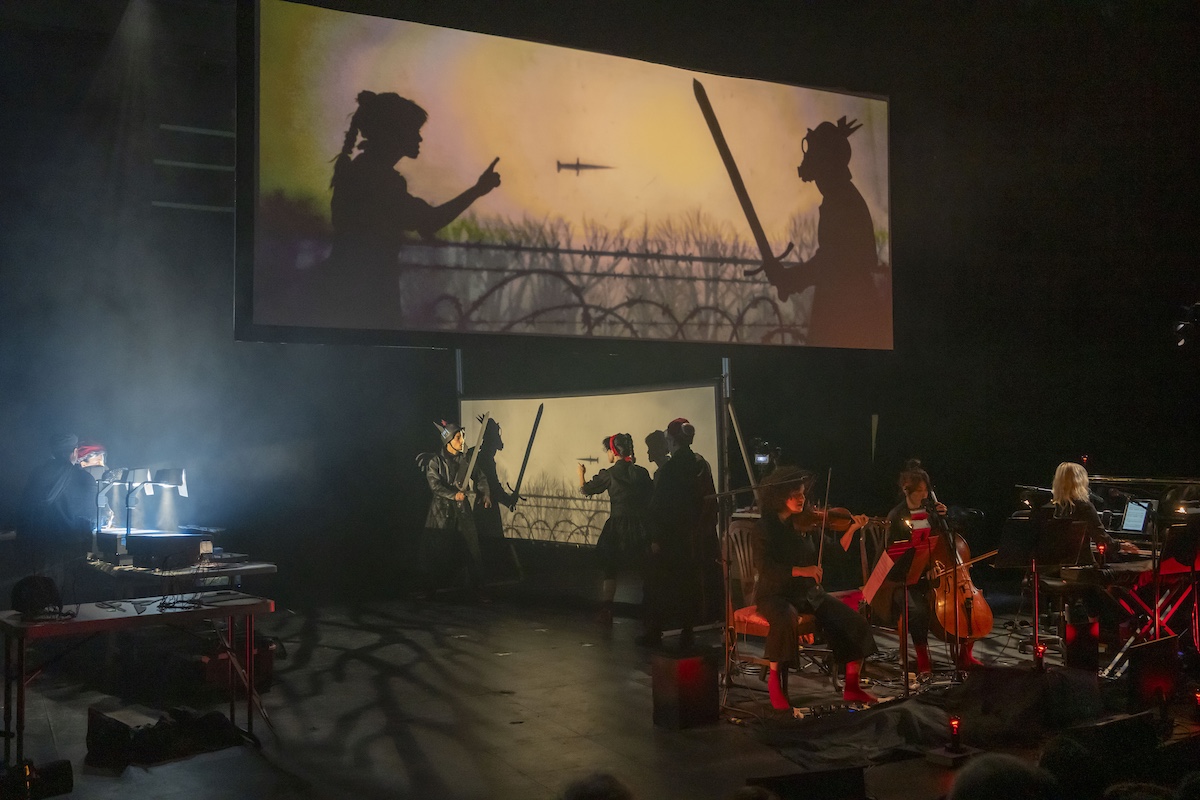
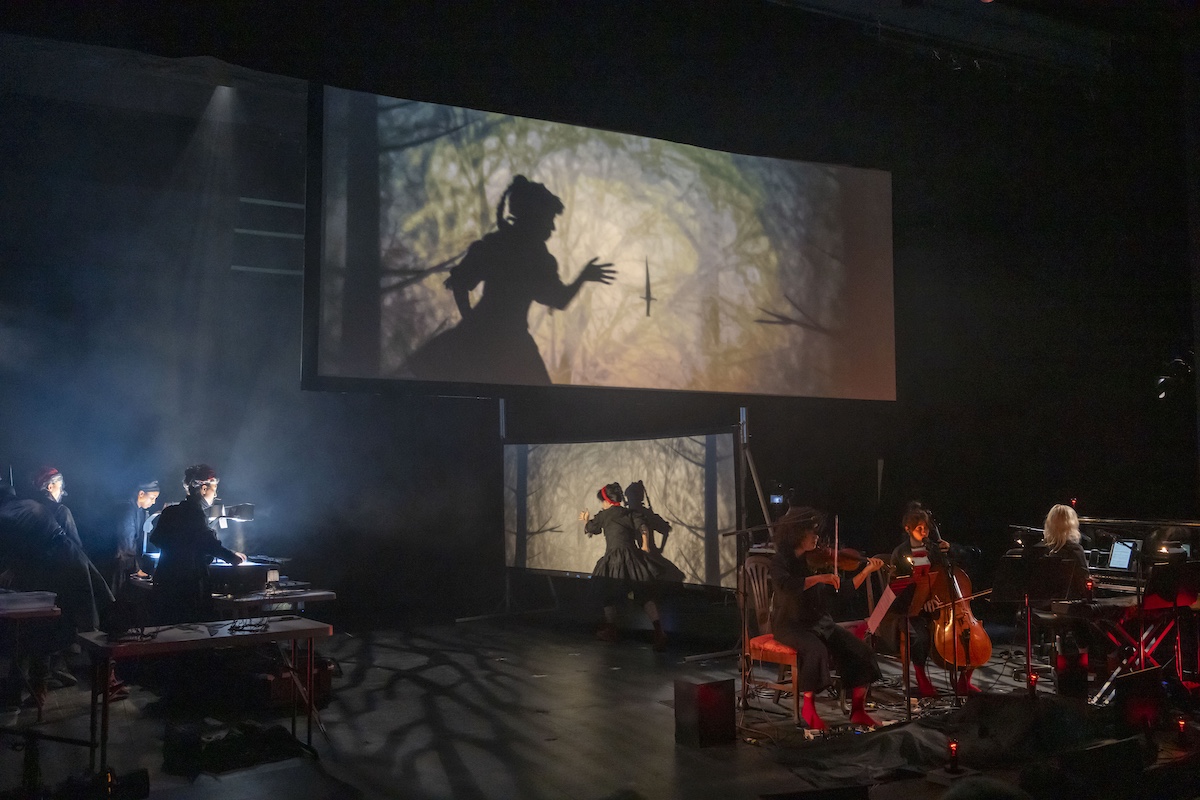
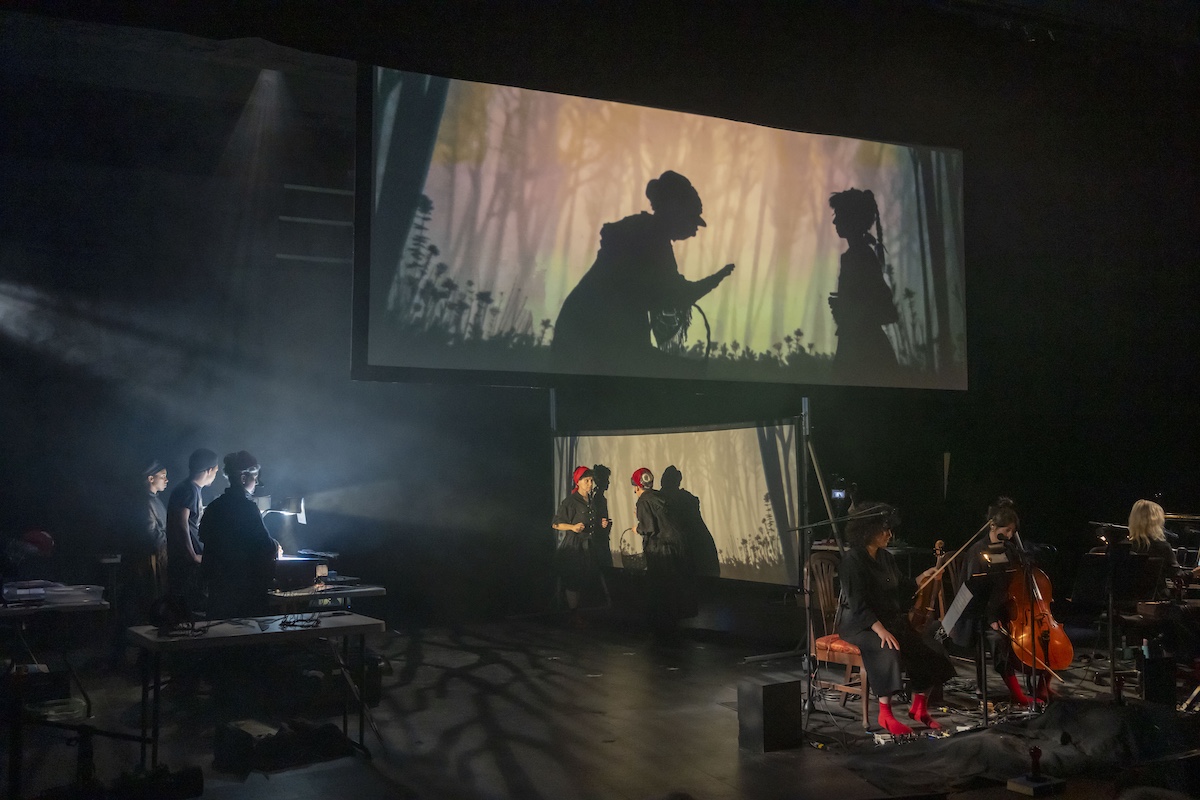
Manual Cinema’s The 4th Witch reimagines Shakespeare’s Scottish play from the perspective of a young girl forced to flee into Birnum Wood when her village is overrun by Macbeth’s army. Tutored by a witch living in the forest, the girl learns to weaponize her fury toward the invaders, transforming her wrath into magical destruction. The girl is initially seduced by the cathartic release of her heedless ferocity, but she eventually begins to question her desire for vengeance when she is confronted with the devastation wrought by Macbeth’s own unfettered rage—a cruelty that the girl discovers is powered by her mentor’s potions. Merging the horrors of Macbeth with a feminist spin on Goethe’s The Sorcerer’s Apprentice, the shadow play combines two-dimensional puppets with human performers to explore the inner recesses of trauma. The visually arresting Expressionist milieu generates an emotionally gripping visual spectacle that graphically depicts the psychological and physical toll of war on women.
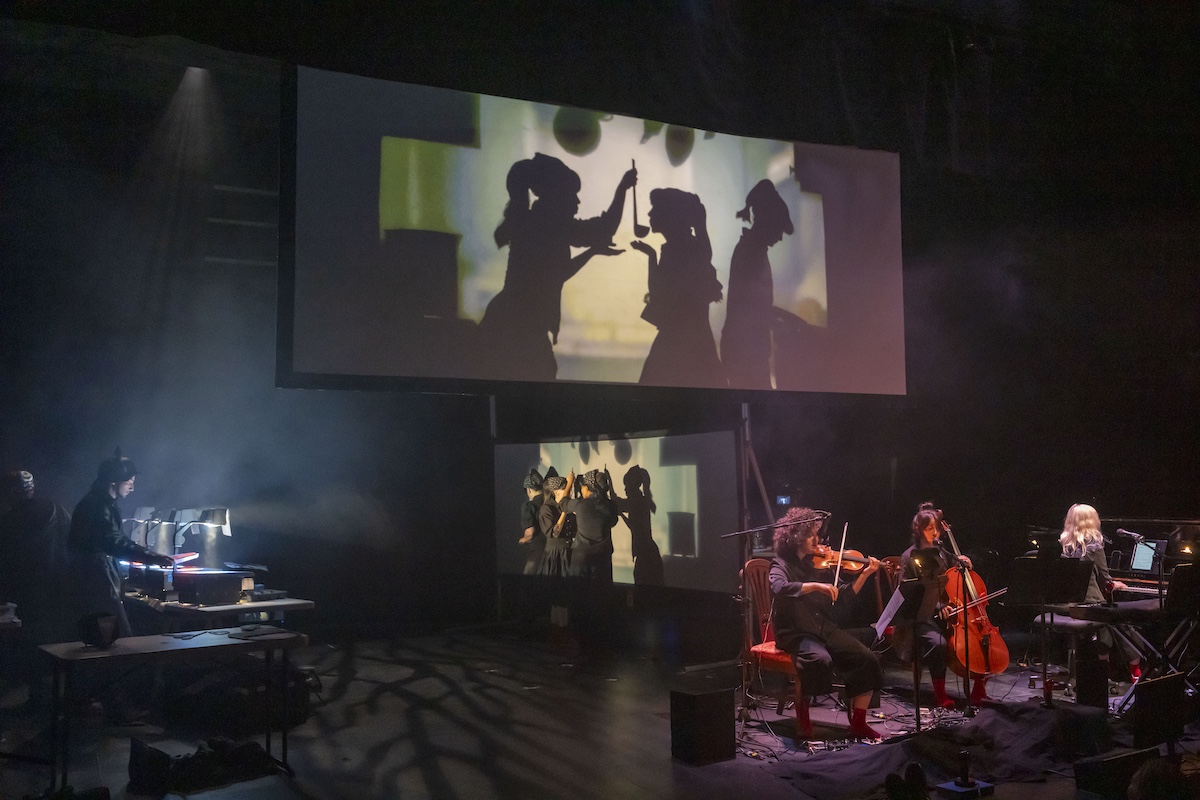
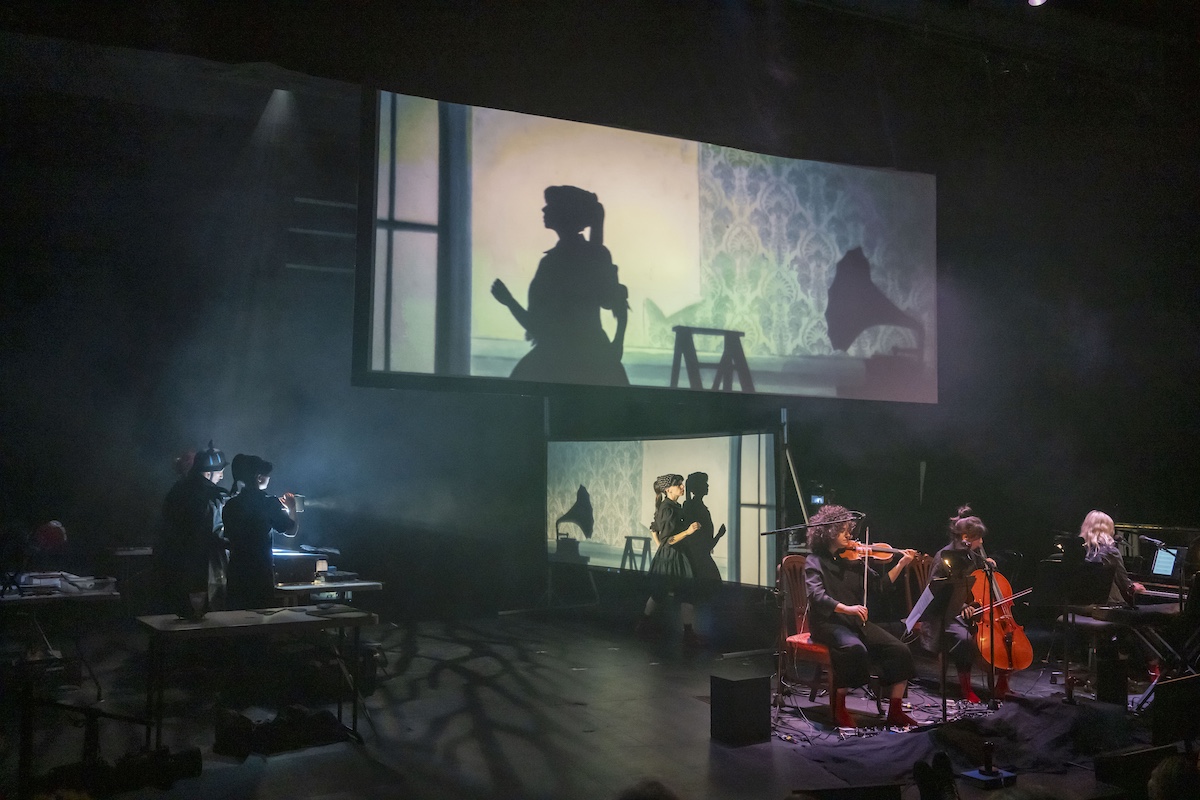
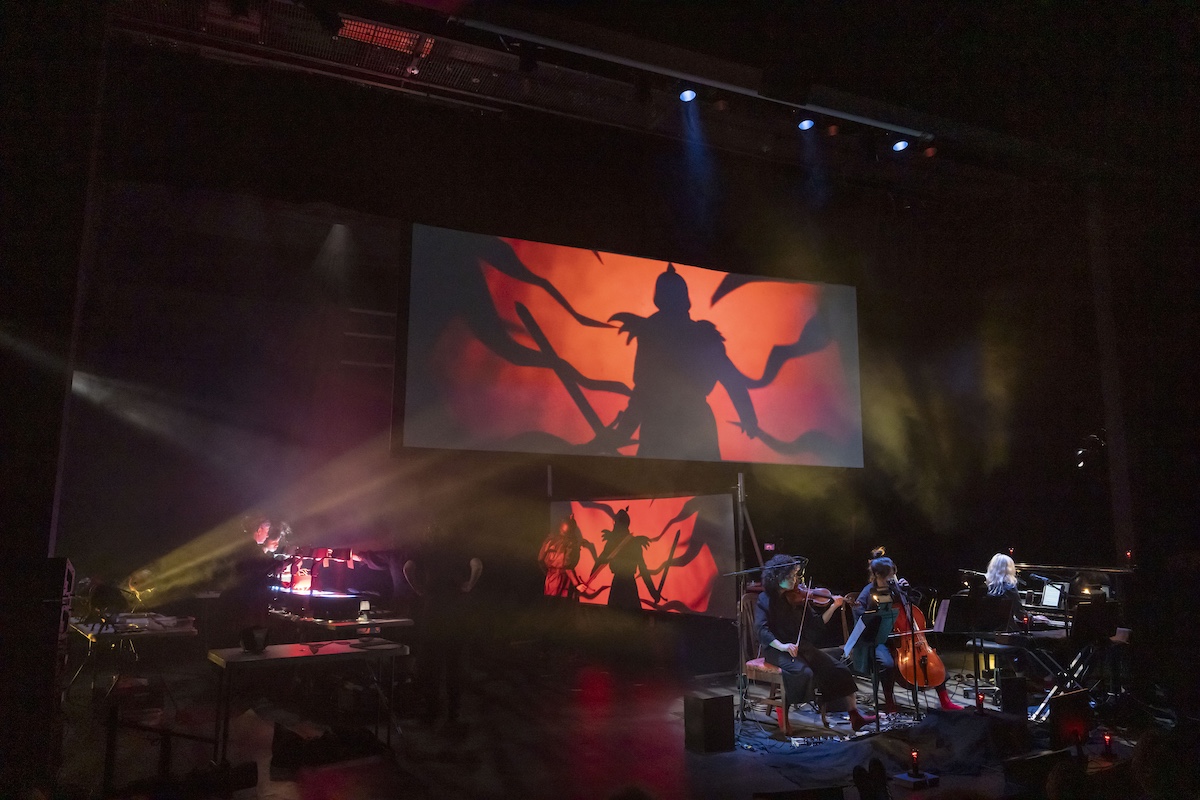
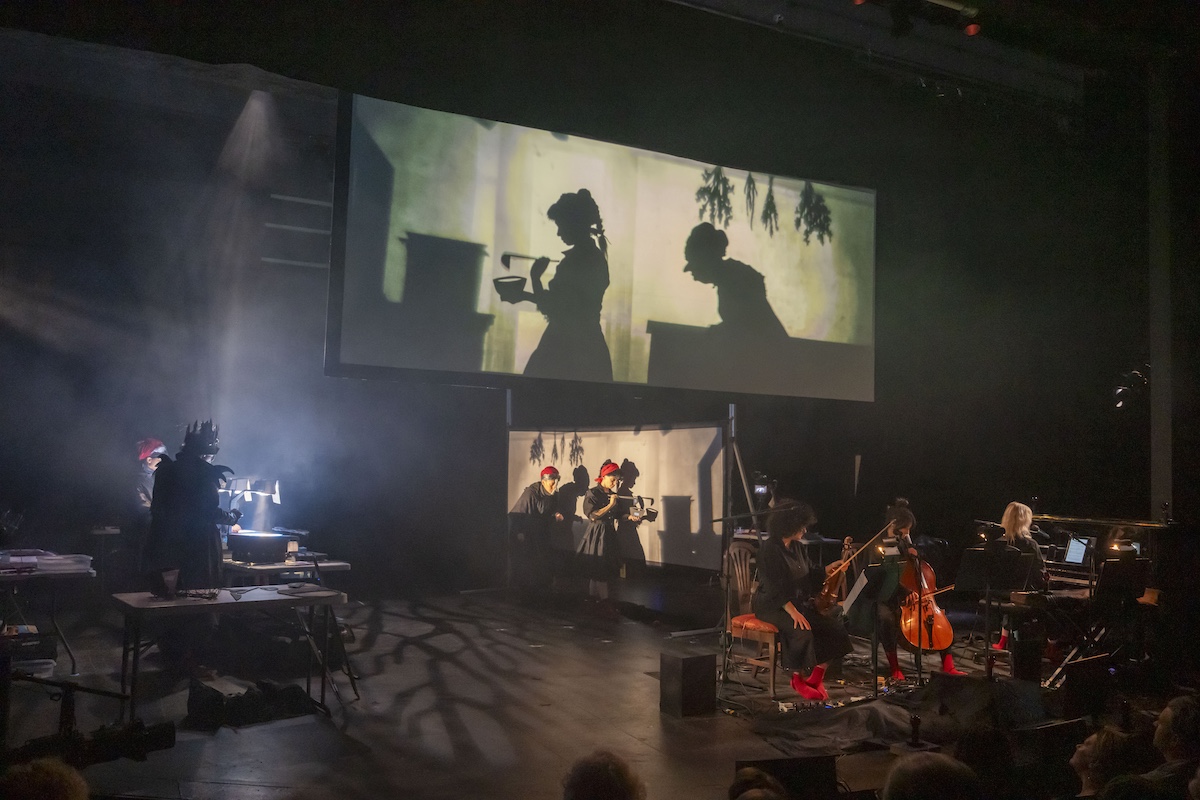
Based in Chicago and a frequent presenter at the Chicago International Puppet Theater Festival, Manual Cinema is a five-person performance collective that consists of three puppeteer/artists (Drew Dir, Sarah Fornace, and Julia Miller) and two musician/composers (Ben Kauffman and Kyle Vegter). Masterfully mingling the silhouettes of actors and puppets on a backlit screen, The 4th Witch is a return to Manual Cinema’s shadow puppet origins. The puppeteers operate four overhead projectors, allowing the company to reproduce cinematographic techniques, such as close-ups and cross-fades, by cutting between overheads. This practice produces an extraordinary interplay between the cast’s silhouettes and the shadow puppets, creating a shared world—a carefully crafted environment whose final composite image has the appearance of a silent film.
Co-commissioned by the Spoleto Festival USA, Cal Performances, ArtsEmerson, and the Wisconsin Union Theater, The 4th Witch deftly combines music, theater, movement, puppets, and the text of Macbeth into a distinctively eclectic style that addresses each organization’s mission on its own terms. One attraction of The 4th Witch that undoubtedly united the four institutions is the marketability of the Bard. Conceived and directed by Dir; devised by Dir, Fornace, and Miller (and incorporating a haunting original score composed by Kauffman and Vegter), The 4th Witch is an exceptionally thoughtful investigation of Macbeth’s dominant tropes—a unique folktale that is neither an adaptation nor a didactic presentation. Instead, the folkloric narrative elucidates the motifs of martial violence, generational trauma, and the wartime suffering of women and children, while reimagining these concepts in a modern context.
A consideration of the play’s diverse funding sources requires an acknowledgement that a predominately wordless, movement-based shadow play may not appear to be an obvious investment. Spoleto USA, which was founded by famed opera composer Gian Carlo Menotti in 1977, has historically focused on music, opera, and dance. Manual Cinema’s exquisite integration of live music is undoubtedly a crucial characteristic that attracted the Spoleto Festival’s interest. Although the actors are silent, live music is foundational to the company’s approach to theater. The soundscape is intertwined with the conceptual environment of the play to such a degree that the musicians become intrinsically vibrant onstage entertainers who cannot be replaced by a recording. As Julia Miller explained during this year’s first Ellen von Volkenburg symposium presented by the festival (“A Labor of Gratitude”), the group functions as a for-profit touring ensemble primarily because their early engagements were booked into venues around Chicago frequented by Kauffman and Vegter, leading the troupe to build a touring practice based on the musicians’ experiences rather than the normative format of touring theater companies. Manual Cinema’s dependence on live music is expensive and, therefore, extremely unusual for a theatrical venture, yet the immediacy of the aural atmosphere is integral to their appeal.
Cal Performances originated with, in their words, “Sarah Bernhardt’s landmark performance in Racine’s Phèdre on May 17, 1906”—only a month after the San Francisco earthquake. Located at UC Berkeley, Cal Performances promotes music, theater, and dance that “foster…life-affirming encounters with the performing arts” and “ignite discovery,” continuing the legacy of hope that Bernhardt’s iconic portrayal of tragic female passion brought to a broken city. The 4th Witch undeniably upholds Bernhardt’s legacy, offering theatregoers a deeply nuanced, hour-long fairy tale that re-creates Shakespeare’s story as an emotional study in female pain and outrage. One of the foremost unanswered questions of Shakespeare’s tragedy is the origin of Lady Macbeth’s inner ire, which initially surpasses her husband’s thirst for blood. The 4th Witch provides a context for this query, drawing on the presence of the witches as a metaphor for the festering of female rancor. In a January 2026 “Behind the Scenes” video for Patreon subscribers [behind a paywall], Sarah Fornace describes the importance of taking girls’ hostility seriously, particularly because girls are not encouraged to explore negative feelings. In February of 2026, the month following Fornace’s video, Simon & Schuster released Angry Girls Will Get Us Through, a young reader’s version of Rebecca Traister’s Good and Mad: The Revolutionary Power of Women’s Anger (2018). Traister’s latest book demonstrates that dismissive attitudes toward women are so endemic that a major publishing company expects to make a profit simply by marketing—to two different age groups—a book acknowledging female fury. Although the timing is coincidental, the willingness of The 4th Witch to tackle the tangled relationship between the toxicity of warmongers and the complicity of injured women seems particularly urgent.
The 4th Witch begins with the famous opening lines of Macbeth—“When shall we three meet again?”—appearing in the style of silent movie title cards. This opening transitions to a French village in the midst of a world war that is simultaneously familiar and peculiar, seamlessly integrating elements from both of the major global conflicts of the twentieth century to emphasize the endless nature of war. A young girl listens to a WWII radio as a newsreader describes Macbeth’s fanatical violence in battle, while the vicious general is depicted wearing a terrifyingly spikey helmet drawn from WWI. The scene quickly shifts to her parents’ restaurant, Les Trois Oiseaux (The Three Birds), where the communal joy of the establishment—the sounds of food cooking, people talking, utensils clinking—gives way to the encroaching tremors of battle. A bomb falls toward the building, and the girl is left alone, finding nothing in the rubble except her father’s bloody glasses. The approaching soldiers are frighteningly faceless in their gas masks, accompanied by a raven who attacks the girl as she runs away into the forest. Lady Macbeth’s ominous raven has seemingly become a spy for Macbeth, hinting at Macbeth’s connection to the Morrigan, the triple Celtic goddess of war and fate (one of many guises the Witches in The 4th Witch seem to employ). Within a few moments, the opening lines have transformed from the Witches’ well-known salutation to a meditation on death and the afterlife—what power might allow the girl to meet her parents again?
The Fourth Witch of the title is both a metaphor and an element of the plot. Ostensibly, the witch living in the forest is one of the three Weird Sisters in Shakespeare’s famous tragedy, while the young girl—as the apprentice—becomes the fourth witch. Long before Shakespeare (as early as 1400, according to the Oxford English Dictionary), the Weird Sisters were interpreted as the Fates, implying that the three women who ensnare Macbeth are not mortal but are instead a representation of destiny. In Manual Cinema’s enigmatic adaptation, the triple persona is perhaps a metaphor for the different attributes of the witch herself. Like the mysterious Morrigan, the witch seems to split herself into three separate personae, though one might also interpret the multiple selves as the presence of other witches reaching out spiritually to provide aid when necessary.
ArtsEmerson (founded in 2010) “work[s] to build diverse audiences” who will “reflect on what’s happening here at home and in the larger world. In this way, we all step into someone else’s shoes and engage with questions of equity and justice.” The 4th Witch clearly fulfills this objective by emphasizing empathy, asking the audience to imagine life from the perspective of the girl, while asking the girl to envision life from the outlook of the witch and, finally, from the viewpoint of Macbeth, whose brutality is heightened by witchcraft. When the girl finally realizes that the witch has been using her labor to distill tinctures that enhance Macbeth’s cruelty, she acknowledges that—as an apprentice—she has become complicit in the war machine. At her moment of recognition, the girl sees blood (or is it simply the juice from red mushrooms?) on her hands, a reminder of Lady Macbeth’s infamous fate.
As a character who does not exist in Shakespeare’s play, the girl’s fate is her own. The Wisconsin Union Theater (WUT), a surprising co-comissioner of The 4th Witch and a treasured feature of my beloved alma mater UW-Madison, has housed numerous fascinating adaptations, including an infamous 1968 production of Peter Pan that included nudity (and featured a young André De Shields). However, music remained the bastion of the official WUT season for many decades. As WUT has expanded its programming to incorporate theater, it is understandable that a company like Manual Cinema—one that unites music and theater—would be included. Yet The 4th Witch also reifies the spirit of UW-Madison, whose anti-war activism is as legendary as its pro-union and pro-Queer activism. From the anti-war bombing of the Chemistry building in 1970 (which killed a graduate student) to the 1966 formation of one of the earliest graduate student labor unions to the rivalry with UC-Berkeley over which school has more Peace Corps volunteers, the students at UW-Madison are well aware of both the productive and destructive potential of untethered rage.
Audiences owe a debt of gratitude to the four institutions that co-commissioned The 4th Witch for their willingness to aid Manual Cinema in a time of increasing darkness for arts funding, and this production showcases the remarkable value of communal support. In the final moments of the play, the girl splits into her three personae and uproots the trees of Birnum Wood, causing the forest to advance toward Macbeth’s army, trapping the men and their instruments of war in the trees’ branches. As the girl returns to her village, fresh grass covers no man’s land. A newly opened restaurant appears—Les Trois Sorcières (The Three Witches)—with the girl, split into three, cooking and serving her customers as the joyous hum of muted conversations and clinking glasses returns. The girl chooses to perpetuate her parents’ legacy rather than the witch’s—to cultivate community rather than spread devastation—while harnessing the powers of witchcraft, which she has brought into balance. After all, anger must be tempered, not repressed or unleashed. A final title card appears on the screen: “When shall we three meet again?,” a reflection on the cyclical nature not only of war and trauma but also of celebration and healing.
Festival Performances
About the Performance
 January 22-25, 2026
The Biograph’s Začek-McVay Mainstage, 2433 N. Lincoln Ave.
A new and fantastic tale from Chicago’s Manual Cinema, inspired by elements of Shakespeare’s Macbeth, in which a girl escapes war and flees into a dark forest. Told through shadow puppetry, actors in silhouette and live music, without dialogue or narration, The 4th Witch begins on the eve of an invasion of a small town by the local warlord, Macbeth. The girl flees into the nearby forest, where, orphaned and exiled, she is rescued by a witch, who adopts her as an apprentice. As the girl becomes more skilled in witchcraft, her grief and rage draw her into a nightmarish quest for vengeance against the warlord who killed her parents: Macbeth. The 4th Witch, an inversion of Shakespeare’s Macbeth, explores themes of grief, war, generational conflict, and cycles of violence through the collateral damage left behind on the battleground.
Reviews + Interviews
Dispatch: International Puppet Theater Festival Launches With Innovative Shows Performed by Puppeteer Teams and Solos by Third Coast Review Staff for Third Coast Review (The 4th Witch review by Kathy D. Hey)
8th Annual Puppetfest Warms the City by Angela Allyn for Chicago Stage and Screen
Witches, Shadows, Sight and Sound: The Puppeteers of Manual Cinema by Finn Morse for The DePaulia
A Beacon of Warmth and Light: Puppets Take Chicago by Laura Collins-Hughes for The New York Times
Sex, sci-fi, Ibsen, and more by The Reader (The 4th Witch review by Kimzyn Campbell)
Review: Everything you ever needed to know about the sex lives of puppets, plus Manual Cinema’s latest by Chris Jones for The Chicago Tribune
Audio: Chicago’s Manual Cinema on why puppets are such a draw in digital age by Mike Davis for WBEZ